

PhD in UK for Indian Students: Fees, Universities, Scholarships, and Eligibility

A PhD in the UK is a long-term research commitment where your research topic, supervisor, university, funding and career plans all matter. 

For Indian students, the UK can be an attractive destination because of its strong research ecosystem, internationally recognised universities and opportunities to work with researchers from different parts of the world. 

PhD in UK for Indian Students can mean very different things depending on the subject, research area, funding route and university you choose. 

This guide walks you through all of it in plain language. Eligibility, English test scores, fees, scholarships, the application process, visa rules, and what to genuinely expect once you land in the UK as a research student.

PhD in UK for Indian Students

Is a PhD in the UK a Good Choice for Indian Students?

Yes, UK can be a strong option for Indian students who want to build a career in research, academia, R&D, specialised professional roles or other fields where advanced research experience is valuable.

One of the biggest advantages is the research environment. UK universities offer doctoral programmes across science, engineering, medicine, business, social sciences, humanities and other specialised fields. Students can also work closely with academic supervisors and research groups.

Another advantage is international exposure. A UK PhD can place you in an environment where you work with researchers, attend conferences, collaborate across institutions and develop research skills that can be useful beyond academia.

However, a UK PhD is not automatically the right choice for everyone. Your research interest, funding position, preferred supervisor, university facilities and long-term career plans should guide the decision.

Not sure if you meet the eligibility criteria?

Get your academic profile evaluated by our counsellors before you shortlist PhD programmes.

Get FREE Profile Evaluation

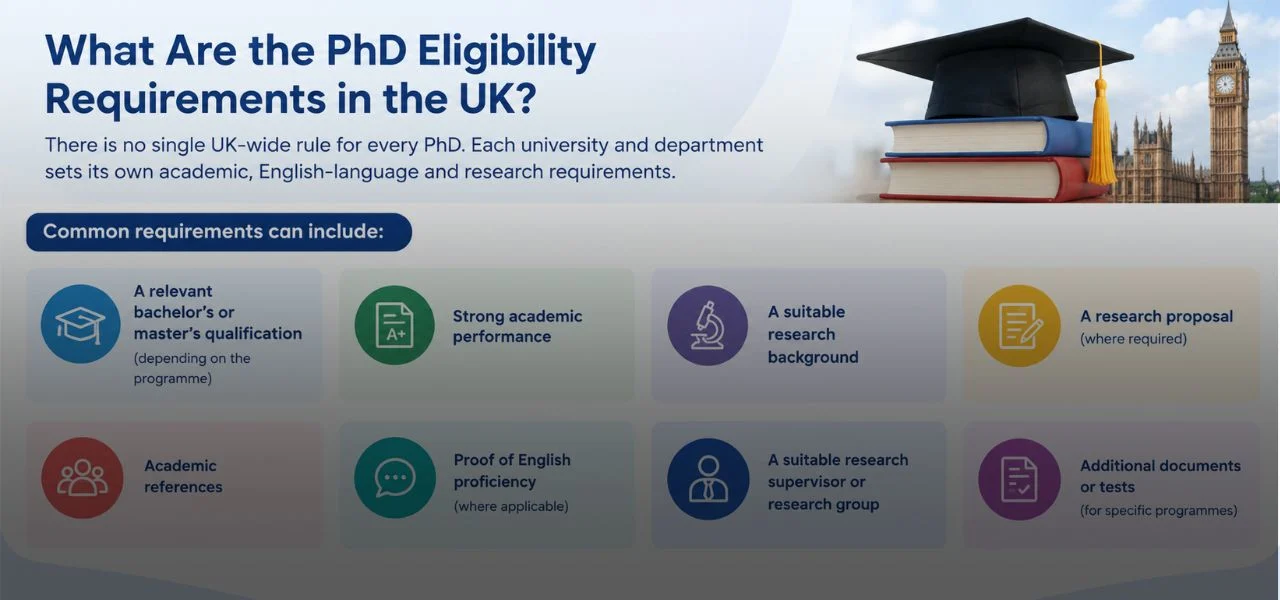
What Are the PhD Eligibility Requirements in the UK?

There is no single UK-wide eligibility rule for every PhD. Universities and individual departments set their own academic, English-language and research requirements.

Common requirements can include:

  • A relevant bachelor’s or master’s qualification, depending on the programme
  • Strong academic performance
  • A suitable research background
  • A research proposal, where required
  • Academic references
  • Proof of English proficiency, where applicable
  • A suitable research supervisor or research group
  • Additional documents or tests for specific programmes
What Are the PhD Eligibility Requirements in the UK

Academic Qualification for a PhD in UK for Indian Students?

Most UK PhD programmes expect applicants to have a strong academic background relevant to their proposed research.

A master’s degree is commonly required, particularly for research-intensive programmes. However, this is not a universal rule.

Some universities or programmes may consider applicants with a strong bachelor’s degree, particularly where the applicant has relevant research experience or the programme allows direct doctoral entry.

For Indian students, the important point is to check how your Indian qualification is assessed against the university’s entry requirements.

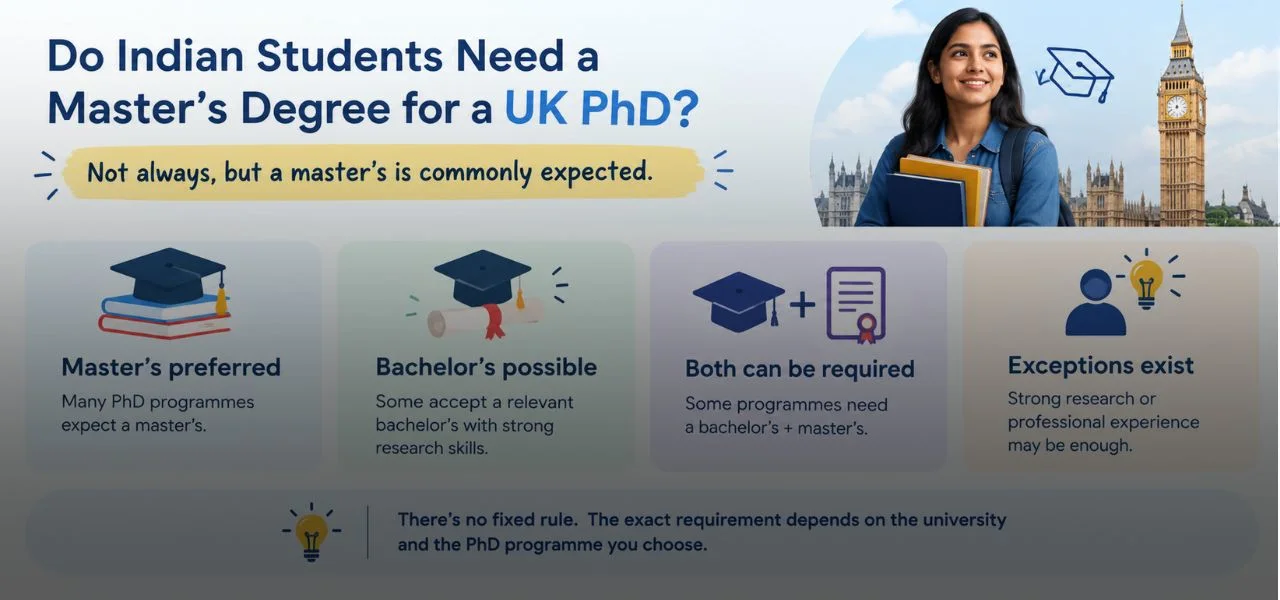
Do Indian Students Need a Master's Degree for a UK PhD?

Not always, but a master’s degree is commonly expected.

Some UK PhD programmes accept applicants with a relevant bachelor’s qualification if they can demonstrate the required academic preparation and research ability. Other programmes specifically require a master’s degree.

Some research programmes require a bachelor’s degree plus a master’s, while others may allow exceptional applicants with suitable research or professional experience to be considered without a master’s. 

Therefore, Indian students should not assume that either “a master’s is always mandatory” or “a bachelor’s is always enough”. The exact university and PhD programme matter.

What Marks or CGPA Do You Need for a UK PhD?

There is no single percentage or CGPA requirement for every UK PhD.

Competitive universities and research programmes may expect a strong academic record, but the required level depends on the university, subject and programme.

Your academic score is only one part of the application. Universities can also consider:

  • Research experience
  • Previous dissertation or thesis
  • Research proposal
  • Academic references
  • Subject knowledge
  • Publications, where relevant
  • Fit with the proposed supervisor
  • Relevant professional experience

Want to know which scholarships you actually qualify for?

Our counsellors can help you identify realistic funding routes before you apply.

Check My Funding Options

Is Work Experience Required for a PhD in the UK?

Usually, work experience is not a universal requirement for a PhD.

Whether it helps depends on the subject and research area. Professional or industry experience can strengthen an application when it is directly related to the proposed research.

Relevant professional experience can strengthen an application when it directly supports the proposed research, but it does not replace the academic and research requirements of the specific PhD programme.

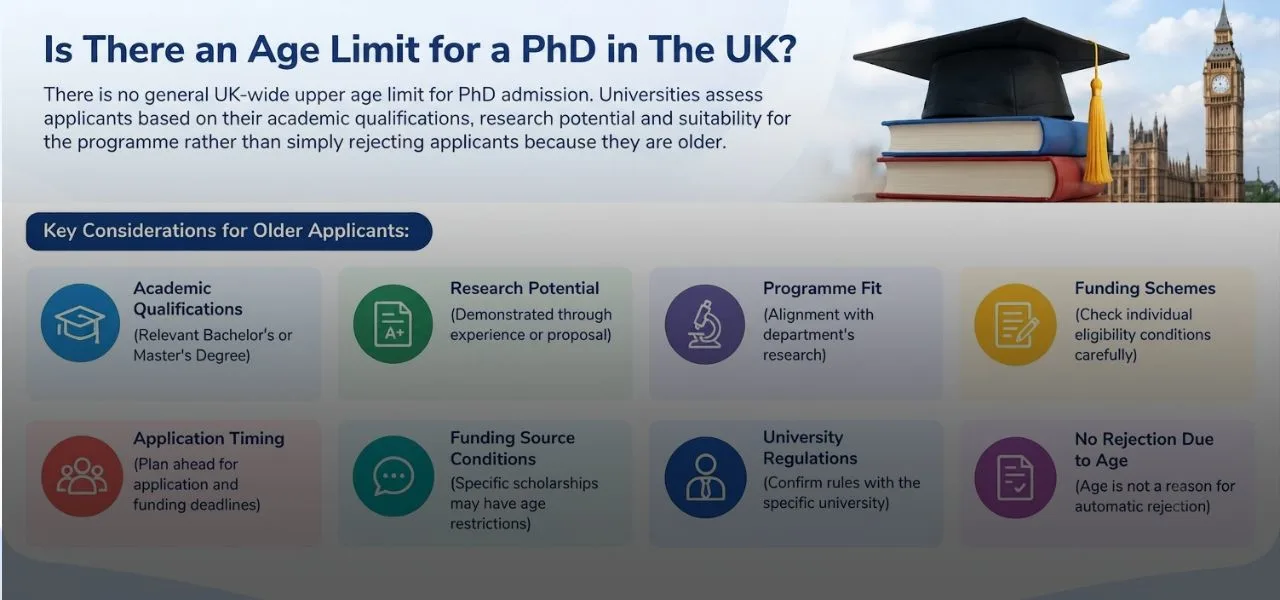
Is There an Age Limit for PhD in UK For Indian Students?

There is no general UK-wide upper age limit for PhD admission.

Universities assess applicants based on their academic qualifications, research potential and suitability for the programme rather than simply rejecting applicants because they are older.

However, individual scholarships or funding schemes can have their own eligibility conditions. Therefore, an older applicant should check both the university requirements and the specific funding conditions before applying.

What Are the English Language Requirements for a UK PhD?

There is no single IELTS score for a UK PhD. English language requirements vary by university, department and programme.

For example, some Oxford DPhil programmes currently require IELTS Academic 7.5 overall with at least 7.0 in each component.

For UK Student visa purposes, degree-level study normally requires English equivalent to CEFR B2, although a higher education provider can assess an applicant’s English itself in permitted circumstances. 

So Indian students should not assume that one IELTS score applies to every UK PhD. If you completed your previous degree in English, you may still need to provide specific evidence depending on the university and visa requirements.

Depending on the university and your previous education, accepted evidence may include:

  • IELTS Academic
  • TOEFL or another accepted test
  • A degree taught in English, where accepted
  • University-specific English assessment
  • Other approved evidence

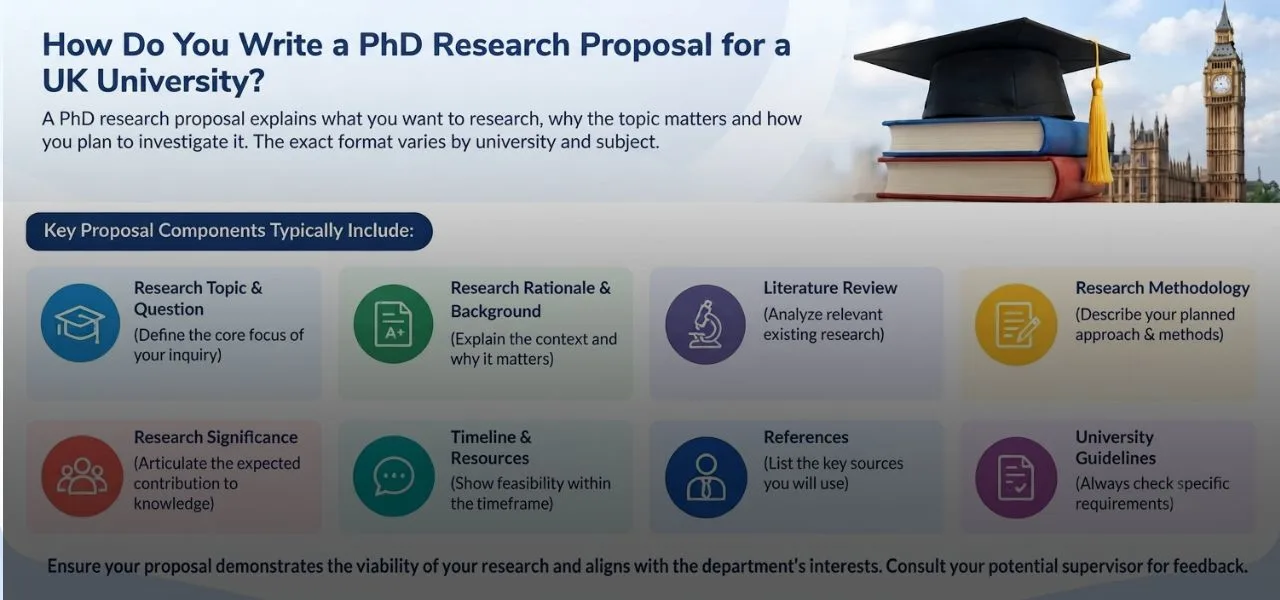
How Do You Write a PhD Research Proposal for a UK University?

A PhD research proposal explains what you want to research, why the topic matters and how you plan to investigate it. The exact format varies by university and subject.

A proposal commonly covers:

  1. Research topic
  2. Research problem or background
  3. Research questions
  4. Existing research
  5. Research gap
  6. Proposed methodology
  7. Expected contribution
  8. References

The proposal should also show that your research question is realistic for the available time, resources and expertise.

Before finalising it, check the university’s specific proposal requirements and any guidance from the department or potential supervisor.

How Much Does a PhD in the UK Cost?

The cost of a PhD in the UK varies by university, subject or programme, fee status and mode of study. There is no single average PhD tuition fee that applies to every international student.

For example, the University of Edinburgh’s 2026–27 postgraduate research fee listings show international tuition fees of £29,000 per year for some PhD programmes and £34,800 for several laboratory-based or science and engineering research programmes. Additional programme costs may also apply to some courses.

Fees data is taken from the official website of University of Edinburgh.

Imperial College London also sets postgraduate research fees by faculty and programme. For the 2026 entry cohort, the overseas tuition fee for postgraduate research programmes in the Faculty of Medicine is £48,700 per year.

Students should also consider living expenses, accommodation, visa costs, travel and other study-related expenses when calculating the total cost of a PhD in the UK. 

Scholarships and studentships may be available for eligible students and can help cover tuition fees and/or living costs.

Have questions about your Student visa or working rights?

Our visa guidance team can walk you through the process once you have your PhD offer.

Get Visa Guidance

What Other Costs Should Indian Students Budget For?

Tuition is only one part of your PhD budget. Indian students should also consider:

  • Accommodation
  • Food and daily expenses
  • Local transportation
  • Visa costs
  • Immigration Health Surcharge
  • Flights between India and the UK
  • Research materials
  • Books and software
  • Conference or fieldwork expenses
  • Laptop or specialist equipment, where required
  • Personal expenses

Research-related costs can vary substantially. For example, some research programmes may involve laboratory work, fieldwork, specialist equipment or conference travel.

Can You Do a Fully Funded PhD in the UK?

Yes, fully funded PhD opportunities are available in the UK, but funding is competitive and should never be assumed.

Funding usually comes from one or more of these routes:

1

UKRI Studentships

UKRI-funded studentships provide a stipend and tuition fee support at the applicable UKRI home-fee level. International students can apply, but places are limited and the difference between the home and international fee may need to be covered separately.
2

University-Specific Scholarships

Such scholarships are usually offered directly by UK universities to eligible postgraduate research students, often in the form of scholarships or studentships.

3

Commonwealth Scholarships

Indian students can also explore external scholarships and funding schemes, but eligibility, eligible countries, study level and funding coverage vary by programme and application cycle.

4

Project or Department-Funded Studentships

These opportunities are usually linked to a specific research project, department or funded doctoral programme and may have their own academic and application requirements.

Popular Universities for a PhD in the UK

The UK has many universities offering doctoral research across different disciplines.

Some well-known options Indian students may explore include:

University Why students may consider it
University of Oxford Broad doctoral research options and strong research environment.
University of Cambridge Extensive postgraduate research opportunities across disciplines.
Imperial College London Strong focus on science, engineering, medicine and related research.
UCL Wide range of doctoral programmes across disciplines.
University of Edinburgh Large postgraduate research portfolio across subjects.
University of Manchester Broad research activity across science, engineering, social sciences and other fields.

This is not a ranking of the “best” universities for every student. The right choice depends on your research topic, supervisor, facilities, funding and career plans. 

What PhD Courses and Programmes Are Available in the UK?

The UK offers doctoral research programmes across a wide range of academic disciplines.

The exact programme title and research options depend on the university.

What Are The Most Popular PhD Subjects in the UK?

Indian students can explore doctoral research in areas such as:

  • Computer Science and Artificial Intelligence
  • Engineering
  • Business and Management
  • Economics and Finance
  • Education
  • Psychology
  • Medicine and Life Sciences
  • Biotechnology
  • Data Science
  • Environmental Science
  • Mathematics
  • Physics
  • Chemistry
  • Law
  • Social Sciences
  • Humanities

The important question is not simply whether a university offers a PhD in your subject. You should also check whether the department has researchers working in your specific research area.

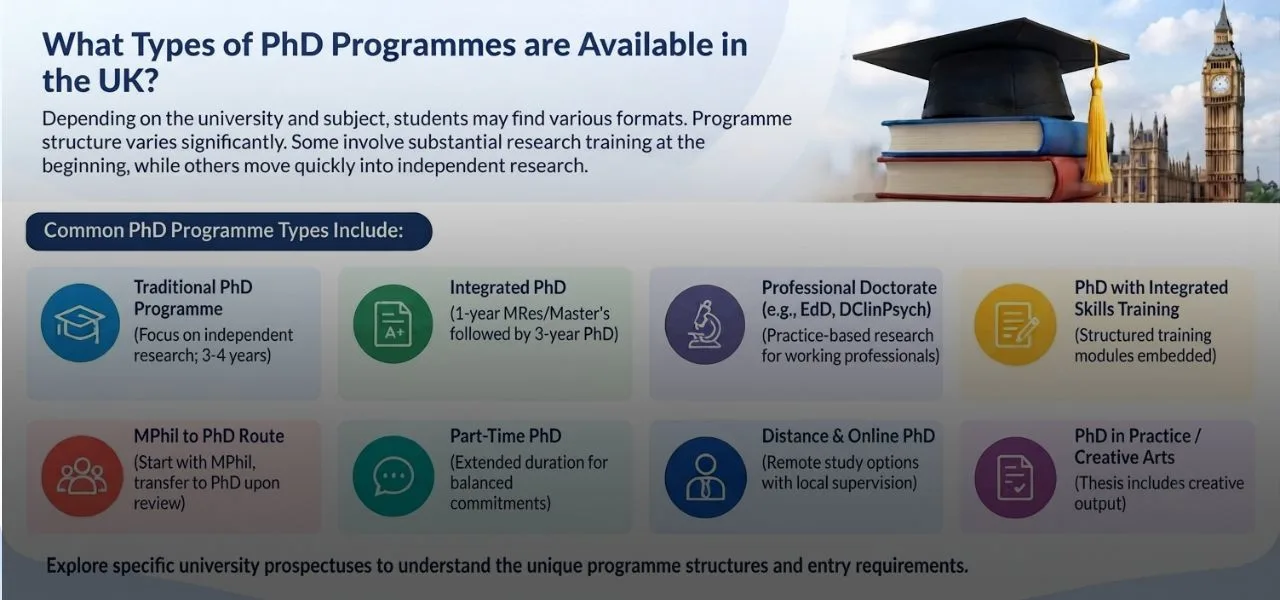
What Types of PhD Programmes are Available in the UK?

Depending on the university and subject, students may find:

  • Traditional PhD programmes
  • MPhil/PhD routes
  • Integrated PhD programmes
  • PhD programmes with structured training
  • Practice-based or professional research routes in selected disciplines
  • Part-time research programmes
  • Distance or flexible research options in selected subjects

Programme structure varies significantly. Some involve substantial research training at the beginning, while others move quickly into independent research.

What Types of PhD Programmes are Available in the UK

What Is The Difference Between a PhD And Doctorate degree?

A PhD is one type of doctoral degree.

“Doctorate” is a broader term that can include different doctoral qualifications. A PhD normally focuses on original academic research and the production of a thesis that contributes new knowledge to the field.

Other doctoral qualifications may be designed around professional practice or specific disciplines.

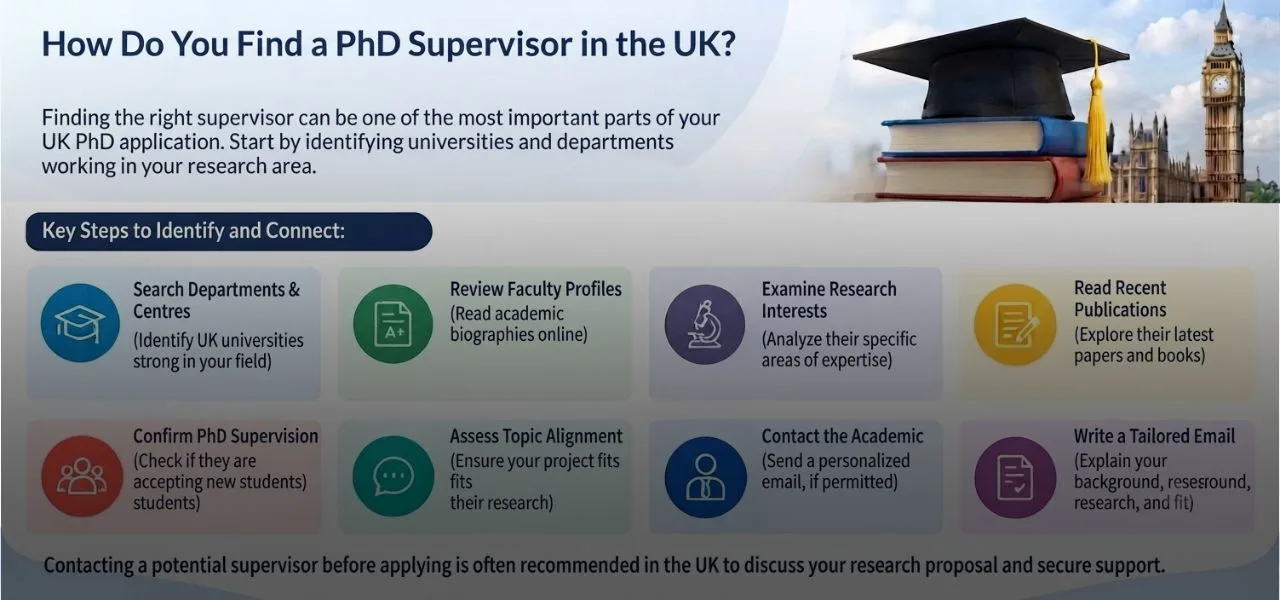
How Do You Find a PhD Supervisor in the UK?

Finding the right supervisor can be one of the most important parts of your UK PhD application.

Start by identifying universities and departments working in your research area.

Then:

  1. Search the university department or research centre.
  2. Read faculty profiles.
  3. Look at the research interests of potential supervisors.
  4. Read some of their recent publications.
  5. Check whether they supervise PhD students.
  6. Compare their research interests with your proposed topic.
  7. Contact the appropriate academic if the university permits or expects applicants to do so.

Do not send the same generic email to every professor.

A better approach is to briefly explain your academic background, proposed research area and why their research aligns with your project.

How Do You Find a PhD Supervisor in the UK

What Is the PhD Application Process in the UK?

The process varies between universities, but Indian students can generally expect the following:

  • Shortlist universities and specific research groups working in your area
  • Identify and contact potential supervisors before submitting a formal application
  • Draft your research proposal
  • Submit the university’s online application with your documents and application fee
  • Attend an interview if the university or department requires one as part of its selection process
  • Receive a conditional or unconditional offer
  • Check funding deadlines early and apply for relevant scholarships or studentships according to their individual application requirements
  • Once you have met your offer conditions and received your CAS from the university, you can prepare and submit your Student visa application if you meet the visa requirements.

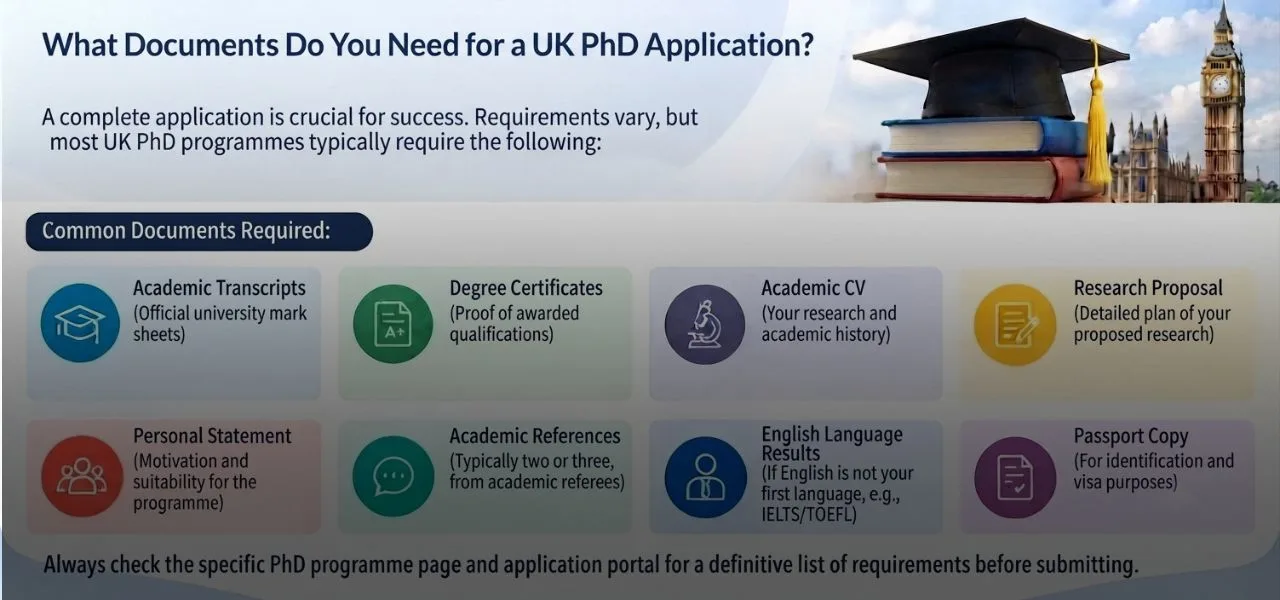
What Documents Do You Need for a UK PhD Application?

Common documents may include:

  • Academic transcripts
  • Degree certificates
  • Academic CV
  • Research proposal
  • Personal statement or statement of purpose, where required
  • Academic references
  • English language test result, where required
  • Passport
  • Writing sample, where required
  • Publications or research evidence, where relevant
  • Portfolio for selected subjects
  • Additional documents requested by the university

The university’s application portal should be treated as the final checklist because requirements vary by programme.

What Documents Do You Need for a UK PhD Application

When Should You Apply for a PhD in the UK?

There is no single UK-wide PhD application deadline.

Some programmes have fixed deadlines, while others accept applications throughout the year.

Many UK PhD programmes offer September or October starts, while some universities and departments also offer other start dates. The available intake depends on the specific programme and funding opportunity.

As a practical approach, starting your supervisor search and university shortlisting around 10 to 12 months before your intended start date. It can give you more time to prepare your proposal, applications and funding submissions.

Can Indian Students Work While Doing a PhD in the UK?

Yes, eligible international students on a Student visa may be allowed to work, but the exact conditions depend on the course and visa conditions. 

For an eligible full-time degree-level course at a qualifying higher education provider, the Student route generally allows up to 20 hours of work per week during term time, with full-time work permitted during certain vacation periods. 

However, students should not treat part-time employment as the main way to finance a PhD. Your primary purpose on a Student visa is study, and there are restrictions on certain types of work.

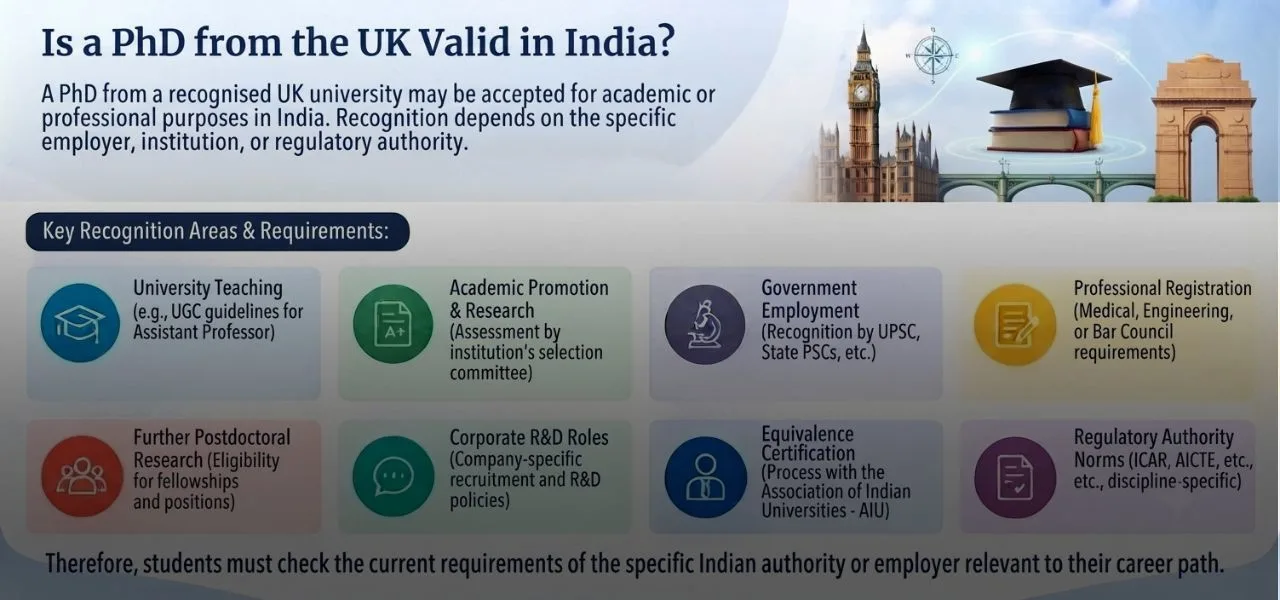
Is a PhD from the UK Valid in India?

A PhD awarded by a recognised UK university may be accepted for academic or professional purposes in India, but recognition requirements can depend on the employer, institution, profession or regulatory authority.

For example, requirements can differ for:

  • University teaching
  • Government employment
  • Academic promotion
  • Professional registration
  • Further study

Therefore, students should check the current requirements of the Indian authority, employer or institution relevant to their intended career.

Is a PhD from the UK Valid in India

PhD in UK vs PhD in India: Which Makes More Sense?

Both options can be suitable, but the better choice depends on your research topic, supervisor, funding, career plans and preferred research environment. 

A UK PhD can be attractive if international research exposure, access to UK research groups and overseas academic networks are important to you. 

An Indian PhD may be more practical if your research and career plans are closely connected to India’s academic or industry ecosystem. Compare the actual programme, supervisor, funding and research facilities before making the decision.

Factor PhD in the UK PhD in India
Research environment Strong international research exposure and collaboration opportunities. Strong opportunities across India's universities, institutes and research organisations.
Programme structure Often focused on independent research with programme-specific training. Structure varies by university and regulatory framework.
Duration Often around 3 to 4 years full-time, depending on programme. Varies by institution and regulations.
Cost International tuition and UK living costs can be substantial. Costs vary and can be lower at some institutions.
Funding opportunities University, UKRI and other studentships are available, but competitive. Fellowships, institutional funding and other schemes may be available.
International exposure Strong opportunity to work in an international research environment. More India-focused unless international collaborations are included.
Career opportunities Can support international academic, research and industry pathways. Strong option for careers focused on India's academic and research ecosystem.

For Indian students who want international research exposure, access to UK research groups and experience in an international academic environment, the UK can be an attractive route.

What Are the Mistakes Indian Students Make When Applying for a UK PhD?

Many PhD applications go wrong before the application is even submitted.

Some common mistakes include:

  1. Choosing a university only because of its ranking 
  2. Ignoring the supervisor fit 
  3. Using a generic research proposal 
  4. Assuming every PhD is funded 
  5. Looking only at tuition fees 
  6. Applying after funding deadlines 
  7. Treating IELTS requirements as universal 
  8. Applying to too many unrelated universities 
  9. Not checking the research facilities 
  10. Planning immigration only after receiving an offer

How Can Education Street Help With Your PhD in the UK?

A PhD application is different from a regular bachelor’s or master’s application. Your research area, academic background, supervisor fit and funding strategy all need to work together. You can connect to our education consultant.

Education Street can help Indian students with:

  • Profile evaluation
  • Research area assessment
  • University shortlisting
  • PhD programme comparison
  • Supervisor shortlisting
  • Research proposal guidance
  • Application documentation
  • Scholarship and funding guidance
  • Offer evaluation
  • Visa guidance
  • Pre-departure support

Ready to explore your PhD options in the UK?

From shortlisting supervisors to your Student visa, Education Street can guide you through every stage.

Book FREE Enquiry Now

Frequently Asked Questions About PhD in UK for Indian Students

What is the eligibility for a PhD in the UK?

PhD eligibility varies by university and programme, but commonly includes a relevant academic qualification, strong academic performance, research suitability, English proficiency where required, and other programme-specific requirements. 

Can Indian students do a PhD in the UK?

Yes. Indian students can apply for eligible PhD programmes at UK universities if they meet the university’s academic, research, English-language and other admission requirements. 

How much does a PhD in the UK cost?

The cost of a PhD in the UK varies by university, subject, programme and fee status. International PhD tuition fees vary by university, subject and research costs. For example, the University of Manchester’s 2026 full-time international PhD fee bands range from £29,900 to £60,800 per year, while the University of Edinburgh lists £29,000 for some classroom-based research degrees and £34,800 for laboratory-based research degrees for 2026 entry. 

How long does a PhD in the UK take?

Full-time PhDs typically take three to four years. Part-time PhDs usually take five to seven years.

Is a PhD in the UK fully funded?

Some UK PhD programmes are fully funded, but not all are. Funding may cover tuition, provide a stipend, or cover specific research expenses depending on the studentship. 

Can international students get UKRI PhD funding?

Yes, international students can usually apply for UKRI-funded studentships, but the number of international places is limited and eligibility is managed by the university or research organisation offering the studentship.

What is the PhD stipend in the UK?

For UKRI-funded studentships, the minimum stipend is £21,805 per year for the 2026/27 academic year. UKRI also lists a London-weighted minimum of £23,805 for eligible students. Individual universities or funding schemes may offer different or enhanced rates.

Can I do a PhD in the UK without IELTS?

Possibly. IELTS is not the only way to demonstrate English proficiency. Depending on the university, visa route and your previous qualification, other accepted evidence may be possible, including a degree taught in English or university assessment. 

Do I need a master's degree to do a PhD in the UK?

Not always. Many programmes expect a relevant master’s degree, but some universities and programmes may consider strong applicants without one. The exact entry requirement must be checked for the specific PhD. 

What documents are required for a UK PhD?

Common documents include academic transcripts, degree certificates, CV, research proposal, references, English-language evidence where required and passport details. Exact requirements vary by university. 

Can I work while doing a PhD in the UK?

Eligible students on the Student route may be permitted to work under specific conditions. For eligible full-time degree-level study, the standard limit is generally 20 hours per week during term time. 

Can I do a one-year PhD in the UK?

A standard full-time PhD in the UK is not normally completed in one year. Doctoral programmes generally require several years of research, with the exact minimum registration period depending on the university and programme.

Can I do a two-year PhD in the UK?

No, a standard full-time PhD is generally longer than two years. Some doctoral programmes may have accelerated or unusual structures.

Are there 3-year PhD programmes in the UK?

Yes. Three years is the typical minimum for a full-time PhD in the UK, though many students take closer to four years to complete and submit their thesis.

Are there 5-year PhD programmes in the UK?

Yes, some research programmes can have longer structures, particularly when part-time study or additional research training is involved. 

Is a PhD free in the UK?

No. A UK PhD normally has tuition and living costs, although a fully funded studentship may cover tuition at the applicable funding level and provide a stipend towards living expenses..

What is the average age of a PhD student in the UK?

There is no single official UK-wide average age that can be safely used for all PhD students. Applicants should focus on whether they meet the academic and research requirements.

Can a PhD lead to PR in the UK?

A PhD does not automatically lead to permanent residence in the UK. After completing your PhD, you may qualify for another immigration route depending on your circumstances.

How Long Does a PhD in the UK Take?

A full-time UK PhD commonly takes around three to four years, but the exact duration depends on the university and programme. Some programmes can be longer, particularly where integrated training, placements or additional research requirements are included. 

Can You Study a PhD in the UK Part-Time?

Yes, some UK universities offer part-time PhD routes. Part-time programmes usually take longer than full-time study. Part time PhD in the UK typically takes 5 to 7 years to complete. However, international students should be particularly careful here because visa rules and work rights can differ for part-time study.

Reviewed by

Ankita Thakker

Study Abroad Counsellor, Education Street

Ankita has guided Indian students through university shortlisting, applications and visa processes for study destinations including the UK, USA, Canada and Australia. This page was reviewed by her for accuracy before publishing.

View Full Profile