Affordable Tuition Fees
Germany has public universities with low or no tuition for many regular degree programmes, but MBA programmes can be an exception because some are continuing-education programmes or are offered by private institutions.


If you are an Indian student planning to pursue an MBA abroad, Germany can be worth considering for its established business schools, English-taught programmes and access to Europe’s largest economy.
An MBA in Germany for Indian students can be particularly relevant for professionals who want international business exposure without automatically choosing the US or UK.
Germany has become an established destination for international students, including students from India. However, MBA costs vary considerably by institution.
Public universities may have relatively low tuition for some programmes, while established private business schools can charge substantial fees. In this blog, we will cover why an MBA in Germany for Indian Students is the right choice.

There are several reasons why Indian students can choose Germany for their MBA:
Germany has public universities with low or no tuition for many regular degree programmes, but MBA programmes can be an exception because some are continuing-education programmes or are offered by private institutions.
Germany has several established business schools offering MBA and management programmes, including Mannheim Business School, ESMT Berlin, WHU, and Frankfurt School.
Germany has a large and diverse economy with major companies across automotive, technology, manufacturing, finance, and other sectors.
MBA graduates may explore roles in areas such as consulting, finance, technology, operations, marketing, and supply chain, although employment depends on qualifications, experience, German-language skills, and the individual employer.
After successfully completing a degree in Germany, international graduates can apply for a residence permit for job-seeking for up to 18 months.
During this period, they can work in any occupation while looking for qualified employment. Once they find suitable skilled employment, they can apply for the relevant residence permit.
Several MBA programmes in Germany are taught in English, particularly at business schools that target international professionals.
However, admission requirements vary, and German can still be useful when looking for internships or employment in Germany.
An MBA can support career progression, international exposure, and access to management-oriented roles, but the return on investment depends on tuition fees, living costs, prior experience, industry, role, location, and post-MBA salary.
Get personalised guidance from our Germany education experts on universities, fees, and eligibility.
Get FREE EnquiryMBA programmes in Germany vary by university and may be offered in different formats, including full-time, part-time and Executive MBA programmes.
Some schools also offer specialised management tracks or focus areas, so applicants should compare programmes individually rather than assume that all German MBAs follow the same structure.
There are 3 common MBA formats and programme types.
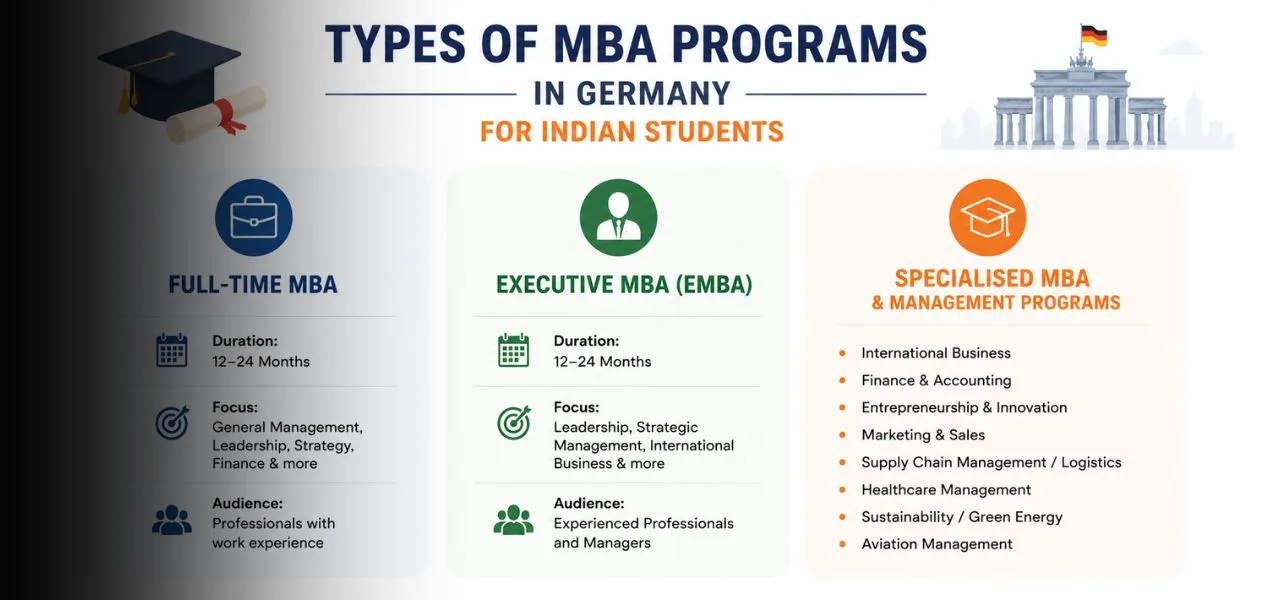
Some German business schools offer MBA programmes with particular industry or management focus areas. Availability varies by institution and intake.
Overall, Germany offers a range of MBA and management programmes, from internationally oriented full-time MBAs to career-focused Executive MBAs.
Students should compare tuition fees, programme content, admission requirements, location and career support before deciding which option offers the best fit.
We have also created a detailed page about Master’s in Germany for Indian Students. You can check out this page.
Yes, 1-year MBA programmes are available in Germany, particularly for students and professionals looking for an intensive full-time MBA. The duration can vary by university, so students should check the official programme details before applying.
Some currently available 12-month MBA programmes in Germany include:
| Business School | MBA Programme | Current Duration |
|---|---|---|
| Frankfurt School of Finance & Management | Full-Time MBA | 12 months |
| WHU – Otto Beisheim School of Management | Full-Time MBA | 12 months |
| IU International University of Applied Sciences | One-Year MBA | 12 months |
Our counsellors can help you shortlist the right business school and plan your entire application.
Talk To Expert NowMBA programmes in Germany are available in different areas of management, depending on the university and business school.
Indian students can choose a programme based on their previous education, professional experience, career goals, and the industry they want to enter.
Depending on the university, MBA programmes in Germany may offer specialisations or focus areas such as:
Students should compare tuition fees, programme content, admission requirements, location and career support before deciding which option offers the best fit.
We have also created a detailed page about Master’s in Germany for Indian Students. You can check out this page.
Germany has several universities and business schools offering MBA and Executive MBA programmes. Some well-known options for international applicants include:
| Business School | Programme | Current Duration |
|---|---|---|
| Mannheim Business School | Mannheim MBA | 12–15 months |
| ESMT Berlin | Full-Time MBA | 15 months |
| Frankfurt School | Full-Time MBA | 12 months |
| WHU | Full-Time MBA | 12 months |
| RWTH Aachen | Executive MBA Technology Management | 4 semesters (2 years) |
Yes, Indian students can find MBA programmes at public universities in Germany, but the options are more limited than the number of public universities available in the country.
Some public universities offer MBA or Executive MBA programmes as specialised or continuing-education courses, and these programmes may charge tuition fees.
Here are some public universities in Germany that offer MBA programmes:
| Public University | MBA Programme | Format / Duration |
|---|---|---|
| Leipzig University | SEPT MBA | Full-time, 4 semesters |
| Technical University of Munich (TUM) | Executive MBA / Executive MBA in Business & IT | Part-time, 4 semesters |
| University of Bayreuth | MBA programmes including MBA Health Care Management, MBA Sport Management, Global MBA Sport Management and MBA Sales Management | Duration varies by programme |
The SEPT MBA at Leipzig University is a two-year, full-time MBA taught entirely in English. It focuses on small and medium-sized enterprises (SMEs) and entrepreneurship.
At the Technical University of Munich (TUM), students can choose from Executive MBA programmes designed for experienced professionals and managers. The programmes are part-time, taught in English and normally take four semesters.
The University of Bayreuth also offers MBA programmes through its continuing-education portfolio, including options in areas such as healthcare management, sport management and sales management.
It is important to remember that studying at a public university does not automatically mean that the MBA is free. MBA programmes can have separate tuition fees because many are professionally oriented or continuing-education programmes.
Let our experienced counsellors guide you through universities, costs, and admission requirements.
Book FREE EnquiryYes, some German business schools accept alternatives to the GMAT for their MBA programmes. Depending on the university, these may include the GRE, Executive Assessment, or an institution-specific admissions test. However, the accepted test and other eligibility requirements vary by programme.
Some German business schools that currently offer alternatives to the GMAT include:
| University / Business School | MBA Programme | Alternative Admission Test / Route |
|---|---|---|
| ESMT Berlin | Full-Time MBA | GRE, Executive Assessment (EA), or ESMT Admissions Test (BAT) |
| Frankfurt School of Finance & Management | Full-Time MBA | GRE or Frankfurt School Admission Test |
| WHU – Otto Beisheim School of Management | Full-Time MBA | GRE, Executive Assessment, or WHU MBA Admissions Test (BAT) |
Therefore, Indian students searching for an MBA in Germany without GMAT should not assume that the GMAT is compulsory for every MBA programme.
Instead, check the current admission requirements of the specific business school and programme to see whether it accepts the GRE, Executive Assessment, or its own admissions test.
Admission requirements vary by MBA programme, but Indian students may typically need:
Some programmes may accept alternative tests or waive standardised testing under specific conditions, so applicants should check the current requirements of each school.
The MBA application process in Germany varies by university and programme, but Indian students can generally follow these steps:
Start by comparing MBA universities and business schools based on programme structure, specialisation, tuition fees, location, work experience requirements, and career support.
Review the university's current eligibility criteria, including academic qualifications, professional work experience, English-language requirements, and GMAT, GRE, or other admission tests where applicable.
Depending on the programme, applicants may need a recognised university degree, CV, motivation letter, academic documents, proof of English proficiency, recommendation letters, and test scores.
Complete the application through the university's specified application system and submit all required documents before the relevant deadline. Some MBA programmes may also include an interview or additional assessment.
If your application is successful, the university will provide an admission or offer letter with information about the programme and enrolment.
After securing admission, eligible international students can proceed with the applicable visa and residence requirements for studying in Germany. Students should check the latest requirements with the German authorities before making travel arrangements.
The cost of an MBA in Germany varies significantly by institution. Some public universities charge low or no tuition for certain programmes, while many MBA programmes at established business schools and private institutions have substantial tuition fees.
Students should also budget for accommodation, food, health insurance, travel and other living expenses.
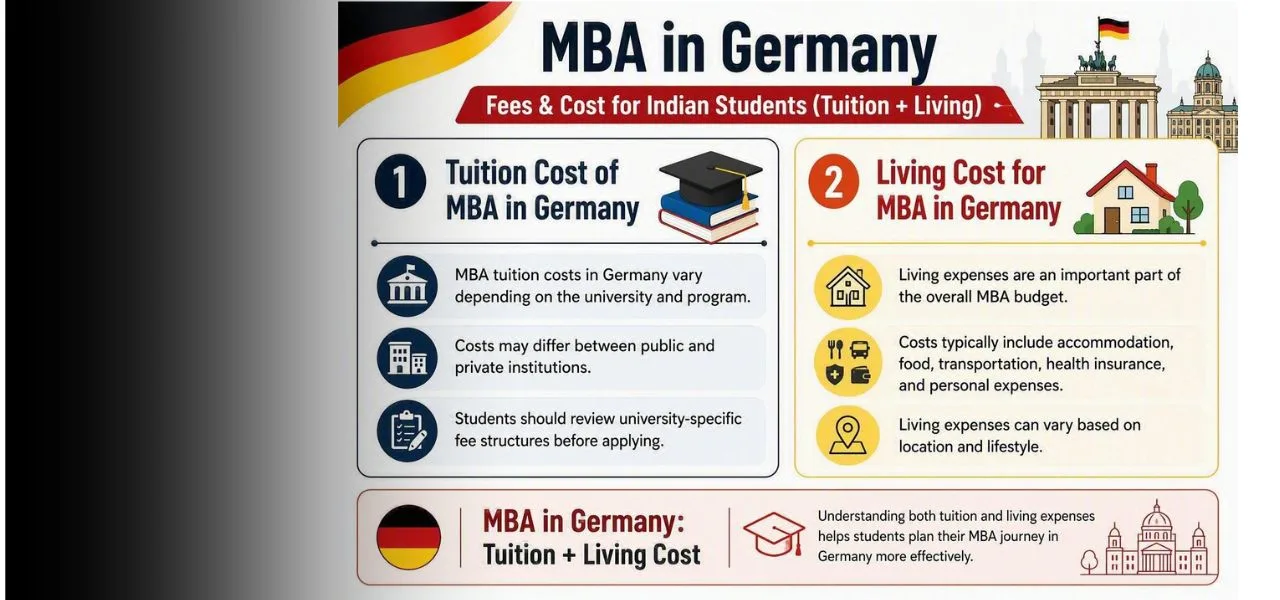
Public universities in Germany generally do not charge tuition for many Bachelor’s and consecutive Master’s programmes, but MBA and continuing-education programmes can have tuition fees.
Baden-Württemberg generally charges non-EU students €1,500 per semester for applicable degree programmes, while some institutions in Bavaria may also charge tuition to students from outside the EU/EEA.
Students at German higher education institutions generally pay a semester contribution. The amount varies by institution and can cover administrative, student-service and other contributions; in some cases, public transport benefits may also be included.
Tuition at established German business schools can be substantial. For example, current published fees include €39,500 for the Mannheim MBA, €50,000 for the ESMT Full-Time MBA and €42,000 for the Frankfurt School Full-Time MBA.
Note: Fees can change by intake.
The official financial requirement for students is at least €992 to €1200 per month, or €11,904 per year, when demonstrating sufficient funds for living expenses.
This is a financial requirement for residence purposes and should not be treated as a guaranteed estimate of actual spending. Your real expenses can be higher or lower depending on accommodation, city and lifestyle.
These numbers can shift over time; university fees change, and so do currency rates. Before you lock in a budget, double-check the latest figures directly on the university’s website or DAAD’s official page.
Our counsellors can help you shortlist the right business school and plan your entire application.
Talk To Expert NowYes, scholarships are available for MBA in Germany, but they depend on the university, MBA programme and applicant profile.
Most opportunities are programme-specific, and some scholarships cover only part of the tuition fees rather than the full cost of studying in Germany. Some funding options Indian students can explore include:
| Scholarship / Funding Option | Where It Applies | What Students Should Know |
|---|---|---|
| DAAD EPOS | Selected development-related programmes, including the SEPT MBA at Leipzig University | Eligibility and funding depend on the specific programme and scholarship conditions |
| University-specific MBA scholarships | Selected German business schools | Awards may be partial and are usually based on the school’s eligibility criteria |
| WHU MBA Scholarships | WHU Full-Time MBA | WHU offers several partial scholarships for eligible MBA applicants |
An MBA in Germany for Indian students can open career opportunities across management, consulting, finance, technology, manufacturing, supply chain, marketing, and business development.
However, your career options after an MBA in Germany will depend on factors such as your MBA specialization, previous work experience, university, practical experience, technical skills, German language proficiency, and the type of role you target.
Management consulting is a popular career path for MBA graduates interested in business strategy, problem-solving, operations, and organizational improvement.
After an MBA, you may explore roles such as:
These roles generally require strong analytical, communication, presentation, and problem-solving skills.
Students with a background or specialization in finance can explore opportunities in corporate finance, financial analysis, banking, risk management, investment-related roles, and financial consulting.
Potential job roles include:
Your previous professional experience and finance-related skills can influence the type and level of position you qualify for.
Germany’s technology sector provides opportunities for professionals who can combine business knowledge with technology and analytical skills. An MBA can be particularly relevant for business-facing positions in technology companies.
Possible career paths include:
Skills in areas such as data analytics, digital transformation, artificial intelligence, and technology management can further strengthen an MBA graduate’s profile.
Germany has a well-established automotive and manufacturing industry, creating opportunities in areas such as operations, strategy, procurement, project management, sales, finance, and supply chain management.
MBA graduates may target roles such as:
Students with an engineering or technical background may also use an MBA to move toward business and management-oriented roles.
Germany’s location and extensive industrial and business network make supply chain, logistics, procurement, and operations important areas for business professionals.
Career options may include:
An MBA specialization in operations or supply chain management can be useful for students targeting these career paths.
An MBA can also lead to careers in marketing, sales, brand management, market research, account management, and business development.
Common roles include:
For roles that involve regular communication with German customers or businesses, German language skills can be an important advantage and may be required for some positions. DAAD notes that many German employers expect strong German proficiency, although requirements vary by field and role.
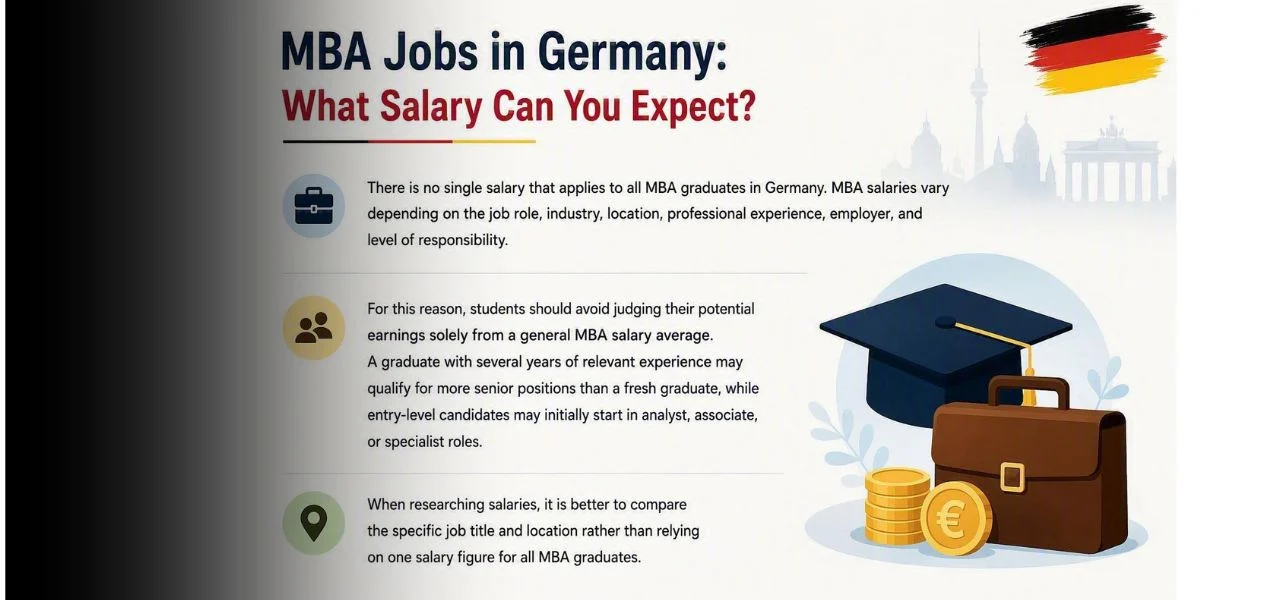
There is no single salary that applies to all MBA graduates in Germany. MBA salaries vary depending on the job role, industry, location, professional experience, employer, and level of responsibility.
For this reason, students should avoid judging their potential earnings solely from a general MBA salary average. A graduate with several years of relevant experience may qualify for more senior positions than a fresh graduate, while entry-level candidates may initially start in analyst, associate, or specialist roles.
When researching salaries, it is better to compare the specific job title and location rather than relying on one salary figure for all MBA graduates.
Some MBA programmes in Germany may admit applicants with limited or no work experience, but many established MBA programmes require relevant professional experience. The requirements vary by institution.
Therefore, Indian students looking for an MBA in Germany should check the work experience requirement of each programme before applying.
Some MBA programmes may accept applicants with less experience, while others are specifically designed for professionals with several years of work experience.
Yes, eligible international graduates who complete their degree in Germany can apply for a residence permit to look for qualified employment after graduation.
According to the German government’s Make it in Germany portal, this residence permit can be issued for up to 18 months. During this period, graduates can work while looking for qualified employment.
Once a suitable qualified job is secured, graduates may be able to switch to an appropriate residence permit for employment or, where eligible, an EU Blue Card. The exact requirements depend on the individual’s circumstances and the applicable immigration rules.
An MBA qualification is only one part of your employability. Indian students can strengthen their profile by:
DAAD specifically recommends gaining practical experience during studies and making use of university career services, company fairs, and other career resources when preparing for employment in Germany.
Yes, an MBA in Germany can be a worthwhile choice for Indian students who have clear career goals, relevant professional experience, and a realistic budget. The value of the degree depends on the MBA programme, university, industry, and career outcomes you are targeting.
Germany offers internationally oriented MBA programmes and exposure to the European business environment. However, an MBA does not automatically guarantee a particular salary or job after graduation.
Before deciding whether an MBA in Germany is worth it, students should consider:
Share your details and our team will call you back to answer all your MBA in Germany questions.
Get an Instant Call BackNo, MBA in Germany is not completely free. Some public institutions offer MBA or management programmes with relatively low tuition, while other MBA programmes, particularly continuing-education and private programmes, can charge substantial fees. Tuition depends on the university and programme
Germany can be a suitable option for students seeking internationally oriented MBA programmes, English-taught courses and exposure to a major European economy. Whether it is the right choice depends on your budget, work experience, career goals and preferred programme.
Work experience is commonly required for MBA programmes, but the minimum varies by institution. For example, ESMT Berlin, Mannheim and Frankfurt School currently list three years of professional experience for their respective MBA programmes
German business schools offer different MBA formats, including full-time MBA, part-time MBA and Executive MBA programmes. Some programmes also have particular industry or management focus areas. The available formats and specialisations depend on the institution.
Requirements vary by business school, but applicants may need a recognised bachelor’s degree, relevant professional experience, English-language proficiency and an admissions test such as GMAT or GRE where required. Universities may also ask for a CV, motivation letter, references and an interview. Check the current requirements of each MBA before applying.
MBA tuition varies widely. Current examples include €39,500 at Mannheim, €42,000 at Frankfurt School and €50,000 at ESMT for their respective MBA programmes. Students must also budget separately for living expenses, insurance and other study-related costs.
Scholarship availability depends on the business school and programme. Some institutions offer partial scholarships or other funding options, while external funding may have separate eligibility criteria.
The right MBA specialisation depends on your career goals, previous experience,, and the type of role you want to pursue. Common areas across German management programmes include finance, international business, technology, operations, marketing, entrepreneurship and sustainability.
Options include Mannheim Business School, ESMT Berlin, WHU – Otto Beisheim School of Management and Frankfurt School of Finance & Management. Students should compare the specific MBA, tuition, admissions criteria, duration, curriculum, and career support before choosing a programme.
Many established MBA programmes require professional experience before admission, so fresh graduates may have limited MBA options.
International students from third countries can generally work up to 140 full days or 280 half-days per year without approval from the Federal Employment Agency. Alternatively, during the lecture period, they may work up to 20 hours per week. Specific rules can vary by residence status and type of work.
Not necessarily. Standardised test requirements vary by business school. Some programmes accept GMAT or GRE, while others may offer their own admissions test or alternative routes.
The requirement varies by programme. Many established MBA programmes expect several years of professional experience. For example, ESMT Berlin, Mannheim and Frankfurt School currently require at least three years for their respective MBA programmes.
The MBA duration in Germany is usually around 12 to 24 months, depending on the university and programme format. For example, ESMT Berlin’s Full-Time MBA takes 15 months, while the SEPT MBA at Leipzig University takes four semesters. Executive and part-time MBA programmes can also take around two years or longer depending on their structure.
Yes, you can find MBA programmes in Germany that do not require the GMAT, but the requirement varies by business school. Some programmes use their own assessment or consider other parts of the application, while others may require a standardised test.
Founder & CEO of Education Street
An MBA graduate from the University of Leeds, UK, Ankita founded Education Street in 2010 and has since personally mentored 10,000+ students on transparent, student-first study abroad guidance across the USA, UK, Canada, Germany, and more.