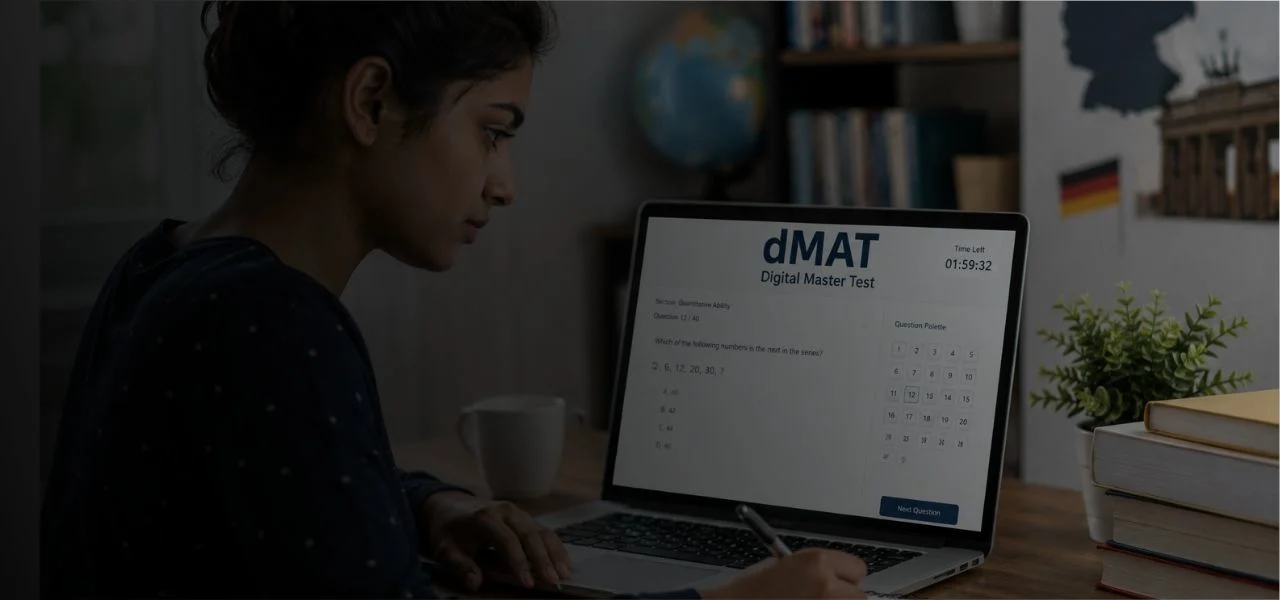
dMAT Exam for Germany Master’s – Eligibility, Exam, APS, Fees & Registration for Indian Students Planning to pursue a Master’s...


Germany has become a popular choice for Indian students looking for quality higher education without the high tuition fees found in some other study destinations.
But choosing Germany for a Master’s is not simply about finding a university with low fees. Your bachelor’s degree, subject background, academic credits, language requirements, APS process, and the specific admission rules of your chosen programme can all affect your options.
For Indian students, there is another important point to consider. APS India has introduced the Digital Master Test (dMAT) as an additional APS requirement for selected Master’s applicants from India in specific academic fields.
This guide to Masters in Germany for Indian Students explains the key steps in the process, from choosing a course and university to APS, dMAT, scholarships, student visa and career options after graduation.

Many state higher education institutions in Germany charge no tuition fees for most Bachelor's and Master's programmes, although exceptions apply.
However, students still need to budget for living expenses and semester contributions. There are also private universities and programmes that charge tuition fees.
Germany can be particularly attractive if you are looking for:
At Education Street, we regularly speak with students who initially ask for “the best university in Germany” but later realise that the right question is, “Which university and course actually match my academic profile and career goal?”
Based on the Germany Master's profiles we assess at Education Street, we encourage students to compare their Bachelor's subjects and ECTS credits with the exact programme requirements before shortlisting universities.
Talk to Education Street's counsellors and get a personalised shortlist based on your Bachelor's subjects and career goals.
Claim FREE Enquiry Now
Germany may be worth considering if you:
You should also be ready to check each university carefully. There is no single eligibility rule that applies to every Master’s programme in Germany.
One of the first questions we at Education Street ask students is not simply, “What Master’s do you want to study?” It is, “What did you study in your Bachelor’s degree?”
In Germany, Master’s admission is generally based on having a recognised Bachelor’s degree in a related subject, and individual universities can also require specific subjects or ECTS credits from your previous degree.
For example, these can be possible study pathways:
| Indian Bachelor's Degree | Possible Master's Areas |
|---|---|
| B.Tech/B.E. Computer Science | Computer Science, Data Science, AI, Software Engineering |
| B.Tech/B.E. Mechanical | Mechanical Engineering, Automotive, Robotics, Production Engineering |
| B.Tech/B.E. Electrical/Electronics | Electrical Engineering, Embedded Systems, Automation, Electronics |
| B.Sc. Mathematics | Mathematics, Statistics, Data Science |
| B.Com | Finance, Economics, Business Analytics, Management |
| BBA | Management, International Business, Business Analytics |
These are possible areas, not guaranteed admission routes. A university may require specific subjects, credits, grades or other prerequisites.
Our advice: Do not shortlist a Master's only because the course name sounds relevant. First compare your Bachelor's subjects and credits with the programme's admission requirements.

Germany offers Master’s programmes across a wide range of subjects. The right course depends mainly on your bachelor’s background, interests, and career plans.
Popular Master’s courses in Germany include:
Some of these subjects can have dedicated course pages, so students should check the detailed eligibility and programme options for their preferred field before making a shortlist.
Talk to Education Street's counsellors and get a personalised shortlist based on your Bachelor's subjects and career goals.
Claim FREE Enquiry NowYes, Indian students can find English-taught Master’s courses in Germany in subjects such as Computer Science, Data Science, Information Systems, Engineering, Business and Management, Economics, Mathematics, and other specialised fields.
DAAD lists English-taught Master’s programmes in Computer Science at the University of Stuttgart and RPTU University Kaiserslautern-Landau, Data Science at the University of Trier, Information Systems at the Technical University of Munich, and Engineering and Management at Technische Hochschule Ingolstadt.
Some examples of English-taught Master’s courses in Germany include:
| Course | Example of an English-taught programme |
|---|---|
| Computer Science | MSc Computer Science at the University of Stuttgart and RPTU University Kaiserslautern-Landau |
| Data Science | MSc Data Science at the University of Trier |
| Information Systems | MSc Information Systems at the Technical University of Munich |
| Engineering & Management | MSc Engineering and Management at Technische Hochschule Ingolstadt |
| Electrical & Computer Engineering | Master of Engineering at Anhalt University of Applied Sciences |
| International Business | MSc International Business at WHU – Otto Beisheim School of Management |
| International Management | MSc International Management, Marketing, Entrepreneurship at Otto von Guericke University Magdeburg |
| Mathematics | MSc Mathematics at TU Darmstadt, with a Data Science specialisation available |
Official Source: DAAD – International Programmes in Germany
These are only examples, not a complete list. Germany has a large number of Master’s programmes, and the available courses, teaching language and admission requirements can vary by university and intake.
Explore top business schools, fees, eligibility and career outcomes for pursuing an MBA in Germany.
Explore MBA in GermanyYes, 1-year Master’s courses are available in Germany, although they are not as common as longer Master’s programmes.
A one-year Master’s programme generally has a standard duration of two semesters, but the exact duration, credit requirements and admission criteria depend on the university and course.
Some examples of Master’s programmes with a 2-semester standard duration include:

| Master's Programme | University | Duration |
|---|---|---|
| Medical Sciences – Cardiovascular Research (MSc) | University of Freiburg | 1 year / 2 semesters |
| International Health (MSc) | Ludwig Maximilian University of Munich (LMU) | 1 year / 2 semesters |
| Global Urban Health (MSc) | University of Freiburg | 1 year / 2 semesters |
| Human Rights and Democratisation (Master) | University of Hamburg | 1 year / 2 semesters |
| Computational Mathematics (MSc) | University of Bayreuth | 1 year / 2 semesters |
| International Law (LL.M.) | Heidelberg University | 1 year / 2 semesters |
| Product Design (MA) | Saar College of Fine Arts | 1 year / 2 semesters |
Program Source links-
Get a personalised application timeline from Education Street so you never miss an intake deadline.
Get My TimelineYou may see terms such as Master’s in Germany, MS in Germany, MSc in Germany, and Master’s degree in Germany while researching universities.
In general, “MS” is commonly used for Master of Science programmes, while “MSc” refers to Master of Science as a degree title. “Master’s” is the broader term for postgraduate study.
For example, a student may search for:
The important thing is not the wording used in the search query. What matters is the actual degree, curriculum, university, eligibility and career relevance.
Germany has many universities offering Master’s programmes, but choosing a university should not be based only on a ranking list.
Some students may prefer research-focused universities, while others may benefit from a more practical and industry-oriented programme. Here are a few popular universities in Germany for a Master’s.
| University | Known For |
|---|---|
| Technical University of Munich (TUM) | Engineering, Computer Science, AI |
| RWTH Aachen University | Mechanical & Electrical Engineering |
| LMU Munich | Sciences, Humanities, Research |
| Heidelberg University | Life Sciences, Research Depth |
| Karlsruhe Institute of Technology (KIT) | Engineering, Technology |
| University of Mannheim | Business & Economics |
The cost of a Master’s in Germany depends mainly on the type of university, the federal state and the programme you choose. For Indian students, it is important to separate tuition fees from the semester contribution and other living expenses.
At most public/state higher education institutions in Germany, there are generally no tuition fees for most Master’s programmes. However, this does not mean that every Master’s programme is completely free.
| Type of Institution / Location | Tuition Fee for Indian Students |
|---|---|
| Most public universities in Germany | Generally no tuition fee for most Master's programmes |
| Public universities in Baden-Württemberg | €1,500 per semester for non-EU students |
| Some public universities in Bavaria | Tuition fees may apply to non-EU students, depending on the university and programme |
| Private universities | Tuition fees generally apply and can vary significantly by programme |
Baden-Württemberg: Non-EU students generally pay €1,500 per semester for Bachelor’s and Master’s degree programmes at state higher education institutions in the state. Certain exemptions can apply.
Bavaria: Tuition fees for students from outside the EU/EEA may also apply at some Bavarian higher education institutions. The amount is decided by the individual institution and can vary by degree programme.
Get a clear breakdown of tuition, semester contribution and living costs for your target city and university.
Get FREE Cost BreakdownEven when a university does not charge tuition fees, students generally have to pay a semester contribution.
This is different from tuition fees and helps cover services such as student services and student representation. At some universities, it may also include or be connected with public transport benefits.
The exact amount varies by university and location. Therefore, Indian students should check the current fee information on their chosen university’s official website before applying.
Living expenses are separate from tuition fees and the semester contribution. The amount can vary considerably depending on the city, accommodation, lifestyle, health insurance, food and transportation.
For this reason, there is no single living-cost figure that applies to every Indian student in Germany. You should prepare a separate monthly budget based on your chosen city and personal circumstances.
Official Source: DAAD – Costs of Education and Living
Indian students often search for the MS in Germany cost in Indian rupees because converting the expenses into INR makes financial planning easier.
Since the Euro-to-Indian Rupee exchange rate changes regularly, there is no fixed INR amount that will remain accurate over time.
For example, if a university charges €1,500 per semester, you can convert that amount using the current EUR-INR exchange rate to estimate the cost in Indian rupees.
Example: If the applicable exchange rate is ₹110 per €1, then:
These are only example conversions. The actual INR amount will change with the exchange rate.
Official Reference: European Central Bank – Euro Foreign Exchange Reference Rates
Indian students can apply for several scholarships and funding opportunities for Master’s study in Germany. However, not every scholarship is open to every student, and eligibility, funding amount, application deadlines and selection criteria vary by programme.
Some scholarships and funding options that Master’s students can explore include:
| Scholarship / Funding Option | Provider | What It Offers / Key Information |
|---|---|---|
| DAAD Study Scholarships – Master Studies for All Academic Disciplines | DAAD | Supports eligible international graduates pursuing a Master's degree in Germany. The current programme provides a €992 monthly scholarship, along with other possible benefits such as insurance and travel-related allowances, subject to the scholarship's terms and eligibility conditions. |
| Deutschlandstipendium | German Federal Government & participating universities/private sponsors | Provides €300 per month, generally for at least two semesters. Selection is handled by the individual university and considers academic performance and other factors. |
| Konrad-Adenauer-Stiftung (KAS) Scholarship | Konrad-Adenauer-Stiftung | Supports selected international students and doctoral candidates at German higher education institutions. Applicants are generally expected to demonstrate strong academic performance and commitment. |
| Other DAAD Scholarships | DAAD | DAAD's scholarship database includes additional programmes offered by DAAD and other selected funding organisations. Eligibility depends on the specific scholarship. |
The DAAD Study Scholarships – Master Studies for All Academic Disciplines is one of the major scholarship options for international students.
The current DAAD programme supports a complete Master’s programme at a state or state-recognised university in Germany and provides €992 per month for Master’s students, along with other benefits specified in the programme announcement.
The Deutschlandstipendium provides €300 per month for at least two semesters. It is available to prospective and enrolled students who meet the admission requirements, but the individual university decides how scholarships are awarded.
The Konrad-Adenauer-Stiftung Scholarship Programme is another option for eligible international students pursuing Master’s or doctoral studies in Germany.
The scholarship is aimed primarily at international students from non-EU countries, with selection based on factors including academic ability and commitment.
Students should use the DAAD Scholarship Database to find scholarships matching their nationality, academic level and subject.
The database includes DAAD programmes as well as selected funding opportunities from other organisations.
Official Source: DAAD Scholarship Database
Our counsellors can help you find DAAD, Deutschlandstipendium and other funding options you may be eligible for.
Check Scholarship OptionsThe DAAD, or German Academic Exchange Service, remains the most well-known funding route for Indian Master’s students.
As per DAAD’s official information, its scholarships typically provide €992 per month for Master’s students, along with health insurance and a one-time travel allowance depending on the specific programme.
We have also found that competition for DAAD scholarships is genuinely tough, since it is one of the most sought-after funding options among Indian applicants.

There is no single eligibility percentage or CGPA that guarantees admission to every Master’s programme in Germany.
The requirements depend on the university and course.
Common requirements may include:
Uni-assist states that applicants generally need an undergraduate degree in a related subject, and the degree must meet the required recognition criteria.
There is no fixed CGPA requirement for a Master’s in Germany. The minimum grade depends on the university and the specific Master’s programme.
Some programmes may require a minimum grade, while others may evaluate your overall academic background and subject-specific requirements.
For Indian students, your CGPA is assessed according to the grading system and admission requirements applicable to your degree and the chosen programme. Therefore, always check the specific Master’s programme’s minimum grade requirement before applying.
Official Sources: Uni-Assist.
GRE is not universally required for every MS or Master’s programme in Germany. Some universities or programmes may ask for GRE or another standardised test, while others may not.
Always check the current admission requirements of the individual programme before booking a test.

APS is an important part of the German study process for many Indian students.
APS India verifies academic documents and educational qualifications issued by Indian educational institutions.
For many Indian applicants the APS certificate is generally required as part of the documentation for the German student visa process. APS India does not decide university admission or issue visas.
For Master’s applicants, the APS process can involve documents such as:
The exact checklist depends on your academic background and procedure, so students should use the current APS checklist instead of relying on an old document list.
APS India introduced the Digital Master Test (dMAT) on 29 June 2026 as an additional element in the APS documentation for selected Master’s applicants from India.
Under the current procedure, it applies to applicants whose previous degree falls within Engineering, Commerce/Accounting/Finance/Economics, or Business/Management and whose application relates to the Summer Semester 2027 intake or later, subject to transitional exemptions.
Here is what you need to know:
We have created a dedicated page for the dMAT exam for Germany. You can check each and every detail about it.
Your Bachelor’s degree title alone may not be enough to determine whether you qualify for a Master’s programme.
Some German universities look at the subjects and ECTS credits you completed during your Bachelor’s degree. For example, a Master’s programme may require a certain number of credits in mathematics, computer science, engineering or another relevant subject.
This means two students with the same Bachelor’s degree title may not necessarily meet the same Master’s admission requirements if their academic coursework is different.
Our counsellors can match your Bachelor's subjects and credits against real programme requirements before you shortlist.
Get FREE Eligibility CheckThere is no single application route for every German university.
Some universities ask international students to apply through uni-assist, while others accept applications directly through their own application portal.
Some programmes may also require a VPD (preliminary review documentation) from uni-assist before you apply directly to the university.
The easiest way to avoid confusion is to check the application method stated on the official programme or university website.
For Indian students, we recommend looking at the process as a sequence rather than treating university applications, APS and visa as separate tasks.
When shortlisting German universities, students often focus only on names and rankings. But the type of institution can be equally important.
Germany also has Universities of Applied Sciences (HAW/FH), which place greater emphasis on applied research, practical teaching and vocational relevance. Traditional universities generally have a stronger focus on fundamental research.
A simple way to think about it:
| If Your Priority Is... | You May Prefer... |
|---|---|
| Research, academic career or PhD | Research-oriented university |
| Practical and industry-focused learning | HAW/FH |
| Strong theoretical foundation | Research-oriented university |
| Applied projects and professional skills | HAW/FH |
A Master’s degree from Germany can open career opportunities across several industries, depending on your specialisation, skills, and work experience. International graduates can find opportunities in fields such as:
Germany’s official Make it in Germany portal identifies IT specialists, engineers, scientists and healthcare professionals among areas where qualified workers are in demand.
After successfully completing a degree in Germany, graduates from third countries can generally apply for a residence permit of up to 18 months to look for qualified employment.
During this period, they may work while searching for suitable employment, subject to the applicable residence rules.
Official Source: Make it in Germany – Prospects After Graduation

A common worry among Indian students is whether they need to speak German to study there. Germany offers many English-taught Master’s programmes, particularly in several technical, scientific and business-related fields, so German may not be required for admission to an English-taught programme.
That said, basic German can be useful for everyday life and may be helpful when looking for internships, student jobs or employment, depending on the role and location. Even when your Master’s is taught in English, learning German can make everyday communication and integration easier.
When looking for Master’s in Germany in English, do not stop at the programme title.
Check the official course page for:
Some programmes may also include German language learning as an additional part of the student experience.
If your long-term goal is employment in Germany, learning German can be a practical advantage even when your Master’s is taught entirely in English.
Let Education Street help you shortlist English-taught courses that match your Bachelor's background.
Find My ProgrammeGermany generally has two main intakes for Master’s programmes: Winter Semester and Summer Semester.
| Intake | Programme Usually Starts | Common Application Deadline |
|---|---|---|
| Winter Semester | September/October | Around 15 July |
| Summer Semester | March/April | Around 15 January |
These are common deadlines, but they are not universal. Universities and individual Master’s programmes can set different application deadlines, particularly for international students.
Some programmes may also accept applications for only one intake. DAAD recommends checking the exact deadline for your chosen programme before applying.
As a practical approach, start preparing around 9–12 months before your intended intake and confirm the exact application deadline on the official university or programme page.
Your document list depends on the university and programme, but commonly requested documents can include:
Do not prepare one generic document package and send it everywhere.
Different universities can have different requirements. Check the official programme page before submitting your application.
Choosing a Master’s abroad is not just about finding a university and submitting an application. The bigger question is whether the course, university and country make sense for your profile.
At Education Street, we can help you work through the process step by step, including:
We also understand that students and parents often have different concerns. Students may focus on the course, university and career, while parents may want clearer answers about costs, safety, accommodation and the overall investment.
Our goal is to bring these questions together before you make a major decision.
We cross-check Germany Master's admission, APS, dMAT, tuition fees, scholarships and post-study information against official sources such as DAAD, APS India, German government portals, uni-assist and individual university websites.
Programme-specific requirements can change, so students should always confirm the latest requirements before applying.
Reviewed by: Ankita Thakker (MBA, University of Leeds, UK)
Founder & Study Abroad Expert, Education Street | 15+ years of experience in international education and career counselling.
Book a free consultation with Education Street's counsellors and get a step-by-step plan.
Claim FREE Enquiry NowMost German universities expect a minimum of 60 to 75 percent, or around 6.5 CGPA out of 10, in your Bachelor’s degree for Master’s admission. Top-ranked universities like TUM or Heidelberg often look for a higher CGPA, closer to 7.5 or 8.0, especially for competitive courses like engineering or data science.
No, most standard Master’s programmes in Germany do not ask for work experience at the time of admission. MBA programmes and select non-consecutive Master’s courses are the exception, and they often prefer or require one to two years of relevant work experience.
GRE is not commonly required for most Master’s programmes in Germany, especially in engineering, computer science and natural sciences. Some MBA or specialised business programmes may still ask for a GMAT score, so check your target university’s requirement before assuming you can skip test prep.
IELTS is typically required if you are applying to an English-taught Master’s programme and your previous degree was not taught in English. Some universities waive this requirement if you submit a Medium of Instruction certificate confirming your Bachelor’s was fully in English.
Most German universities ask for an overall IELTS band of 6.0 to 6.5 for Master’s programmes, with no individual section below 5.5 or 6.0. Highly competitive courses at top universities, or subjects like business and humanities, sometimes require a 7.0 or higher.
No, German is not required to get admission into an English-taught Master’s programme in Germany. Some universities ask for basic A1 or A2 German at the time of enrolment rather than application, so it’s worth checking your specific programme’s language policy.
Yes, you can complete an entire Master’s degree in Germany without speaking German, since hundreds of English-taught programmes exist, mainly in engineering, computer science, data science and business. Coursework, exams and research work are all conducted in English for these programmes.
The most reliable way is to search DAAD’s official International Programmes database, which lists every state-recognised English-taught Master’s course in Germany by subject and university. You can filter results by field of study, degree type and city to shortlist programmes that fit your background.
German language proficiency is not a general requirement for admission into English-taught Master’s courses in Germany. A small number of programmes set their own subject-specific rules asking for basic A1 or A2 German, so always confirm this on the specific course’s official admission regulations.
Yes, learning basic German, even at an A2 or B1 level, is genuinely useful even if your coursework is entirely in English. It makes daily life, part-time work and building local networks noticeably easier, and it also helps if you plan to work in Germany after graduation.
Yes, most Indian students study for a Master’s in Germany without a scholarship, since public university tuition is largely free or low-cost regardless of scholarship status. You will still need to prove funds through a blocked account, which stood at €11,904 for the year as of 2026, to cover your living expenses.
After completing your Master’s degree, you can stay in Germany for up to 18 months on a post-study residence permit to search for a job related to your qualification. This period does not require a job offer in hand, but you must be actively job hunting.
Yes, you can work in Germany after your Master’s, either during the 18-month job search period in part-time or bridge jobs, or full-time once you secure a qualified role. Graduates in eligible fields can also apply for the EU Blue Card, which offers a faster path to long-term residency.
dMAT Exam for Germany Master’s – Eligibility, Exam, APS, Fees & Registration for Indian Students Planning to pursue a Master’s...
Preview – PhD in Germany Hero PhD in Germany Guide · Trusted Since 2010 PhD in Germany for Indian Students:...

Studienkolleg in Germany: Complete Guide for International Students A Studienkolleg is an institution that acts as a preparatory bridge for...
Starting your Bachelor’s journey in Germany is an incredibly exciting prospect, but we understand that navigating the application process can...
Are you currently dreaming of pursuing a Master’s degree in Germany? We understand that navigating the application process can be...
Preview – Study in Germany Hero Study Abroad Guide · Trusted Since 2010 Study in Germany for Indian Students –...