


1 Year Master’s Programs in New Zealand: Fast-Track Your Global Future
Studying abroad is a significant decision for both students and parents. For those who want to study a Master’s in New Zealand without committing several years to a postgraduate degree, 1-Year Master’s Programs in New Zealand for Indian students could be an excellent option.
Our page covers everything you need to know about fast-track postgraduate courses in New Zealand, including why New Zealand is a great choice, top universities offering these degrees, and popular specialisations.
Our complete guide to a Master’s in New Zealand covers all duration options in detail.
What Are 1-Year Master’s Programs & Why Are They Popular?
Before we talk about 1-year MS in New Zealand, let’s understand how the education system in New Zealand works. New Zealand’s system is very similar to the UK’s because it’s a Commonwealth country.
-
Education Structure
- Early Childhood Education (ECE) – Optional but popular. Focuses on play-based learning for children up to 5 years old.
- Primary & Secondary Schooling – Follows the national curriculum set by the Ministry of Education, ending with NCEA exams.
- Primary School: Ages 5–12
- Secondary School: Ages 13–17
- Tertiary Education – Includes universities, polytechnics (ITPs), and Māori institutions (wānanga). Offers courses from certificates to PhDs. Usually starts after age 18.
-
Higher Education in New Zealand (Tertiary)
For most international students, study begins at the tertiary stage. There are two main types of institutions:
- Universities – Research-focused, and they offer master’s and PhD degrees in New Zealand.
- Polytechnics / ITPs – More practical and career-oriented, with strong industry training.
-
Master’s Programs in New Zealand
- Specialised & Intensive – Build on your bachelor’s knowledge and focus only on your field.
- British Education Model:
- Bachelor’s – 3 years
- Master’s – 1 year (taught) or 1.5–2 years (research)
- This means the master’s duration in New Zealand typically depends on whether you choose a taught or research-based program. This is a question many students ask when comparing how many years a master’s degree actually takes.
- Difference from US/Canada – There, bachelor’s degrees take 4 years, and master’s programs take 2 years.
If a 1-year program isn’t the right fit for your goals, New Zealand also offers 1.5 to 2-year Master’s options, particularly for research-based degrees or specialisations requiring more in-depth study.
One-year master’s programs are designed to offer focused, intensive study that aligns with global standards, allowing students to earn a full postgraduate degree in just 12 months.

These fast-track postgraduate degrees are especially popular among Indian students pursuing an MSc or MS abroad. This pathway is also beneficial for working professionals.
Top Universities Offering 1-Year Master’s in New Zealand
Here is a shortlist of the top universities offering 1-year Master’s programs. This is useful if you are building your own New Zealand university list for master’s research.
| University | Known For |
|---|---|
| University of Auckland | Business, IT, Engineering, Health Sciences |
| University of Otago | Health, Science, Business |
| Victoria University of Wellington | Law, Public Policy, Creative Arts |
| University of Canterbury | IT, Engineering, Environmental Studies |
| Massey University & Waikato | Management, Finance, Digital Disciplines |
| AUT & Lincoln University | Technology, Business, Agriculture, Tourism |
For a detailed comparison including QS rankings, see our complete guide to universities for a Master’s in New Zealand.
Each university maintains strict academic standards, ensuring you receive a quality education in just a year. If you want to connect with the expert counsellors of Education Street and want FREE counselling, then simply 👉 fill the form page.
Popular Specialisations and Courses in New Zealand
One-year master’s programs in New Zealand offer many choices. The most in-demand include
- MBA (Master of Business Administration)
- MSc IT & Computer Science
- Master of Management & Logistics
- Master of Engineering (various streams)
- Finance, Marketing, Data Analytics
- Environmental Science, Food Science
- Public Health, Health Management
- Tourism, Hospitality, Agribusiness
- Human Resource Management
- Pharmaceutical Sciences
- Agriculture & Applied Sciences
- Information Systems & Governance
You will have lots of options; choose the course that fits your passion and goals. Most 1-year Master’s programs are full-time only; part-time master’s degree options are limited and typically only available for a small number of specialisations.
Who Can Apply for a One-Year Master’s Program in New Zealand
These are the eligibility requirements for pursuing a one-year master’s in New Zealand. If you’re researching master’s in New Zealand requirements in detail, here’s what most universities look for
Eligibility for 1-year programs follows the same general requirements as any Master’s in New Zealand — a recognised bachelor’s degree, IELTS/PTE/TOEFL scores, SOP, LORs, and proof of funds.
Some programs may ask for related work experience or specific academic background. Education Street’s team will help you check and confirm the exact eligibility details.
For the complete eligibility breakdown, see our Master’s in New Zealand eligibility guide.
How to Apply for a 1-Year Master’s in New Zealand – Step by Step
Applying for a 1-year Master’s in New Zealand follows a fairly straightforward process, especially with the right guidance. Here’s how it typically works:
- Shortlist your course and university based on your academic background, budget, and career goals.
- Check entry requirements for your specific program – some courses ask for relevant work experience or particular undergraduate subjects.
- Prepare your documents – academic transcripts, IELTS/PTE/TOEFL scores, SOP, LORs, and updated CV.
- Submit your application directly to the university or through an official application portal.
- Receive your offer letter – conditional or unconditional, depending on whether all requirements are met.
- Apply for your student visa once you have an unconditional offer and proof of funds.
- Plan your arrival – accommodation, pre-departure briefing, and travel arrangements.
Is a Master’s in New Zealand Worth It for Indian Students?
If you’re comparing study destinations, here’s an honest answer: New Zealand works particularly well if you want a shorter, focused Master’s without compromising on global recognition. Degrees from New Zealand universities are recognised worldwide, and the country consistently ranks among the safest and most welcoming for international students.
That said, it isn’t automatically the “best” choice for everyone. If your priority is a larger alumni network in India or a bigger city experience, the UK or Canada might suit you better. If your priority is completing your degree quickly, gaining strong post-study work rights, and studying in a smaller, safer environment, New Zealand is genuinely one of the strongest options available.
Course Format and Duration of One-Year Master’s Programs in New Zealand
These short master’s programs follow a full-time, fast-track learning format designed for students who want a complete postgraduate qualification without a multi-year commitment.
- A mix of classes, workshops, project work, and assignments
- Some programs may include internships or work with real projects
- Research-based programs for those who want academic careers, and job-focused courses for quick career growth
- In just 12 months, you will be prepared for jobs, higher studies, or launching your own business.
Here we have also prepared detailed content about job & career opportunities after study in New Zealand.
Tuition Fees & Living Costs for 1-Year Master’s in New Zealand for Indian Students
Tuition fees for 1-year master’s programs in New Zealand usually range from NZ$28,000–NZ$45,000 (roughly ₹13–22 lakh INR), depending on your university and course. In New Zealand, yearly living costs are usually between NZ$15,000 and NZ$20,000 (₹7–10 lakh INR). Remember:
Note: INR figures are approximate and based on prevailing exchange rates, which change frequently. Always confirm the current AUD/NZD to INR conversion before making financial decisions.
- Fast-track means you pay only for a single year, saving on living costs like food, rent, and travel.
- Many Indian students find the overall cost affordable, considering the benefits and return on investment.

Scholarships for 1-Year Master’s Degrees in New Zealand
Scholarships worth checking out include the New Zealand Excellence Awards (NZEA) for Indian students, along with university-specific merit scholarships.
Note: Fully funded scholarships covering 100% of tuition and living costs are rare and highly competitive. Always check official university and government scholarship pages for the most current offerings.
Career Paths Following a 1-Year Master’s Degree in New Zealand
After graduation, if you complete an eligible Master’s that includes at least 30 weeks of full-time study in New Zealand, you may be eligible for a Post Study Work Visa of up to 3 years. 1-year Master’s graduates find strong demand in IT, business, healthcare, and engineering roles.
How Education Street Helped Their Students for a 1-Year Master’s Program in New Zealand
Education Street has successfully sent students to New Zealand for their studies at the Auckland University of Technology (AUT). Here are some students’ names & their reviews:
- Yash Patil – MSc Supply Chain Management
- Tejas Patil – MSc Supply Chain Management
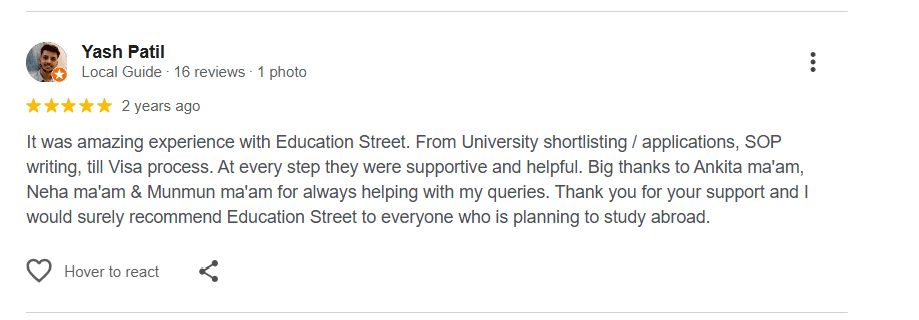
Yash Patil’s Review:
“From University shortlisting/applications, SOP writing, till Visa process. At every step they were supportive and helpful.”
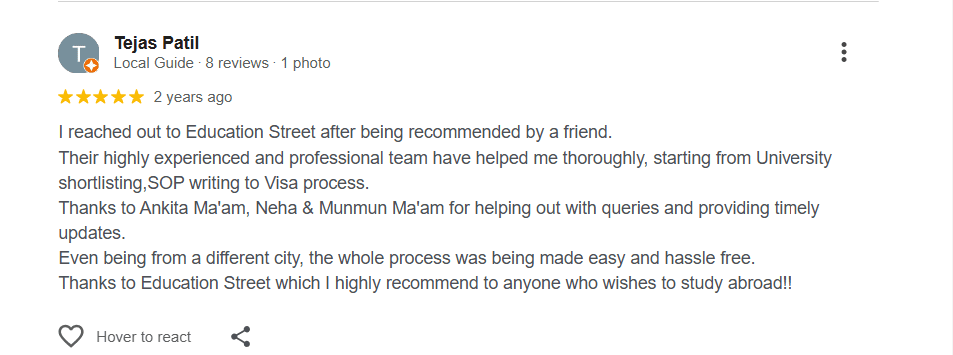
Tejas Patil’s Review:
“Their highly experienced and professional team have helped me thoroughly, starting from University shortlisting, SOP writing to Visa process.”
You can find the same and more students’ success stories to our Google Business Profile.
How Education Street Can Help You with 1-Year Master’s Programs in New Zealand
Students looking for complete overseas education support can connect with Education Street Mumbai for expert guidance on university shortlisting, applications, scholarships, visa process, and career planning.
Choosing, applying, and securing admission isn’t easy, but Education Street makes it simple, from shortlisting universities and writing your SOP to visa filing and pre-departure briefings. We provide counselling across India and online, so location is never a barrier.
Ready to Start Your 1-Year Master’s Journey in New Zealand?
Don’t wait, give your child a global advantage faster. Book a free enquiry session with Education Street today. Our experts will answer all your questions, help you pick the right program, and guide you every step of the way.
Frequently Asked Questions Related to 1-Year Master’s Degree in New Zealand
Is New Zealand good for a Master’s degree?
Yes, particularly if you want a shorter, globally recognised degree with strong post-study work rights. It suits students prioritising speed and safety over a larger network or bigger city life.
Can you complete a Master’s in one year?
Yes. New Zealand follows the UK-based education model, where taught Master’s programs are designed to be completed in 12 months of full-time study.
Which countries offer 1-year Master’s degrees?
New Zealand, the UK, and Ireland are the most common destinations offering 1-year taught Master’s programs. The USA and Canada typically require 2 years.
How much does a 1-year Master’s in New Zealand cost for Indian students?
Total costs, including tuition and living expenses, generally range from ₹20 lakh to ₹32 lakh, depending on the university and city. Exact figures should always be confirmed with the university, since fees change periodically.
Is a 1-year Master’s eligible for a post-study work visa?
Yes. If your Master’s degree includes at least 30 weeks of full-time study in New Zealand, you’re generally eligible for a Post-Study Work Visa of up to 3 years, as per Immigration New Zealand.
Do I need work experience to apply?
Not usually. Most programs require only a recognised bachelor’s degree and English proficiency scores. Some specialised courses, like certain MBA programs, may prefer or require relevant work experience.
Author Name: Ankita Thakker
Designation: Founder & CEO of Education Street