
By Ankita | 31 July, 2025

One-Year Courses in the UK for Indian Students

Thinking about studying abroad but unsure about the time and costs involved? Do you know the UK has a 1-year master’s system? The UK follows a focused and intensive academic approach. These Fast-track programs allow international students, especially Indian students, to obtain a globally recognized qualification in a shorter time scale. If you want to advance your career, change your field of study, or want more international exposure, one-year courses in the UK allow you to do so quickly. 

In this blog, we will review everything you need to know about a one-year course in the UK, the types of one-year courses, the best universities, costs, eligibility, and how Education Street can assist you throughout the process.

Why Choose a One-Year Course in the UK?

  • Takes Less Time: In most countries, master’s courses have a duration of two years, but in the UK, most master’s programs take 12 months.
  • Financial Savings: Students can save lakhs of Rupees due to one year less of tuition and living costs.
  • Globally Accepted Degrees: UK universities are highly reputable worldwide.
  • Employment opportunities: With a UK degree, it opens up job roles across Europe, the US, and India.
  • Post-study work Visa: It allows students to live and work in the UK for 2 years after completing their course.

Types of One-Year Courses in the UK

Several UK universities offer short-term courses that can be completed in a short period of time. These include:

  • Many Indian students choose one-year master’s programs such as MA, MSc, or MBA.
  • Postgraduate Diplomas and Certificates
  • Professional Certifications
  • Short Skill-Based Courses are ideal for working professionals.

These courses teach useful skills and help students get ready for jobs.

Types of One-Year Courses in the UK with Job

Top Categories of a One-Year Course in the UK

Some of the most in-demand one-year courses in the UK include:

  • Business & Management (MBA Programs, Marketing, HR, Finance)
  • Engineering & Technology (Data Science, AI, Cybersecurity, Civil Engineering)
  • Health & Life Sciences (Public Health, Nursing, Biotechnology)
  • Arts & Design (Fashion, Interior Design, Graphic Design)
  • IT & Computer Science (Software Engineering, Big Data, Cloud Computing)
  • Hospitality & Tourism Management
  • Law (LLM)

Top universities in the UK offer these courses to match what companies need today.

Cost of Studying One-Year Courses in the UK

The overall cost depends on your course and university, but here’s a general idea:

Expense Average Cost (INR)
Tuition Fees ₹14 to ₹ 30 Lakhs
Living Expenses ₹10 to ₹13 Lakhs per year
Health Insurance ₹1,40,000 (approx.)
Visa Fee ₹63,000 (approx.)


One-year programs in the UK save at least ₹10–15 Lakhs compared to two-year programs in other countries.

Eligibility Criteria and Admission Requirements

For admission into a one-year UK program, these things are generally required

  • Bachelor’s Degree (Minimum 60% and above)
  • An English language score is required, for example, IELTS (6.5+), TOEFL, or PTE.
  • Statement of Purpose (SOP)
  • Letters of Recommendation (LORs)
  • Updated Resume
  • Work Experience (for MBA or professional programs)

If this seems difficult, don’t worry. Education Street will guide you step by step.

Best UK Universities with One-Year Programs

These UK universities are known for offering quality one-year programs.

  • University of Warwick
  • University of Edinburgh
  • University of Leeds
  • University of Manchester
  • University of Glasgow
  • Cranfield University
  • University of Birmingham
  • King’s College London
  • University of Nottingham
  • University of Bath

These universities have a high standard of teaching, good facilities, and strong links with the industry.
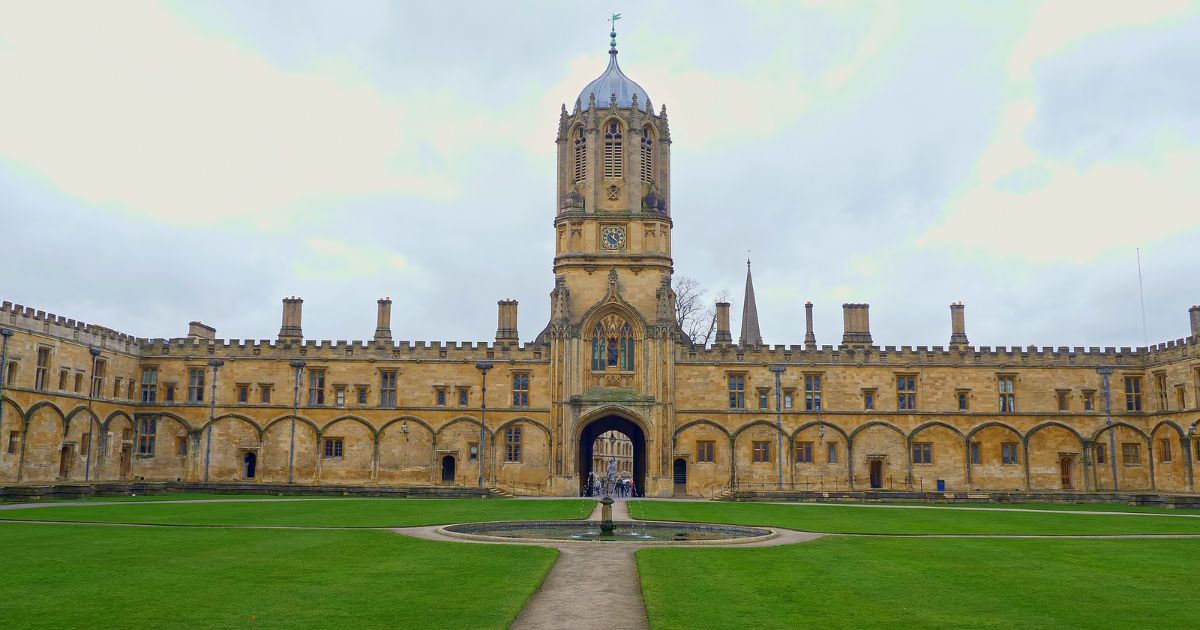
UK Universities with One-Year Programs

Availability of Scholarships

Indian students can apply for several UK scholarships even for one-year courses. Some of them include.

  • Chevening Scholarships
  • Commonwealth Scholarships
  • GREAT Scholarships
  • Charles Wallace India Trust Scholarships
  • University-Specific Scholarships (Bristol Think Big, Warwick Chancellor’s)

Scholarships can help significantly reduce your tuition fees. Apply early, as many are competitive and deadline-based.

Post-Study Work Option in the UK

Once you finish your one-year course, you’ll qualify for the UK Graduate Route Visa, which permits you to remain and work in the UK for 2 years.

  • Students can take up full-time jobs in sectors related to their field.
  • Experience working internationally.
  • Apply for long-term skilled worker visas thereafter.

This visa gives you the chance to recover your investment and grow your career globally.

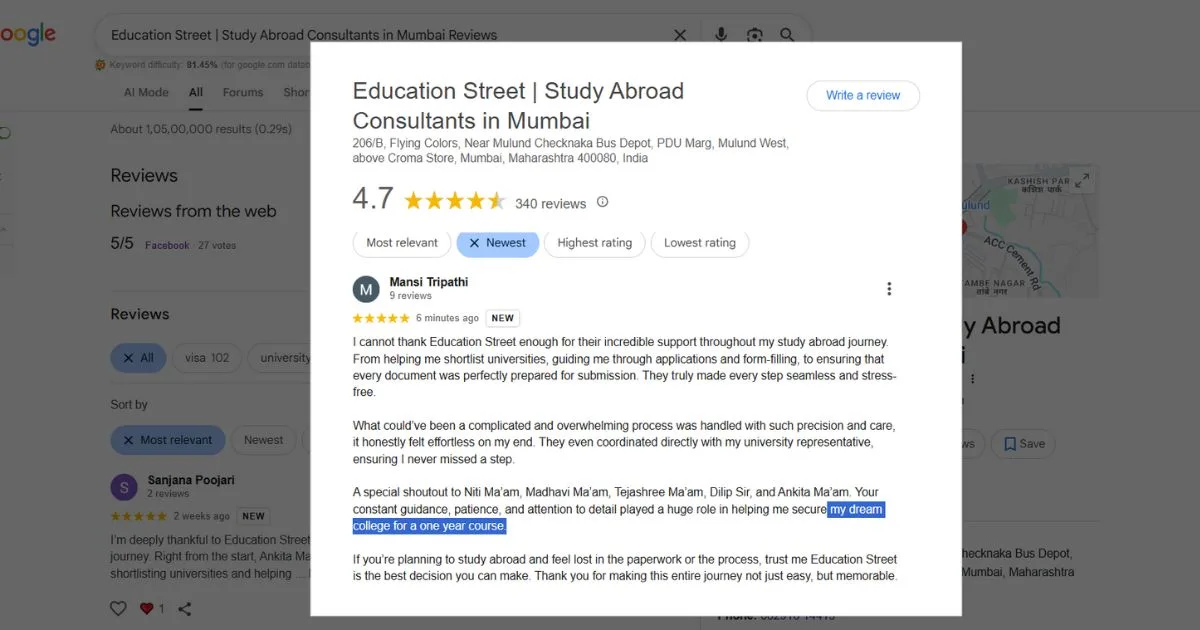
Our Student Testimonials

Here is the student’s testimonial who we helped to pursue One-Year Courses in the UK. We have helped them in the end-to-end process from University selection, application, till the Visa process.

A special shoutout to Niti Ma’am, Madhavi Ma’am, Tejashree Ma’am, Dilip Sir, and Ankita Ma’am. Your constant guidance, patience, and attention to detail played a huge role in helping me secure my dream college for a one-year course.
– Mansi Pradeep Tripathi.

Mansi Tripathi Testimonials

Education Street helped me secure admission to the MSc Digital Marketing program at the University of Salford for the September 2024 intake. Their guidance in choosing the right course and preparing my application made everything simple and stress-free.”
– Apurva Nitin Varia.

How Education Street Can Help You to Pursue 1-Year Courses in the UK.

With 15 years of experience, Education Street provides full support for students in their UK admission process, including:

  • Personalized Career Counselling
  • Course & University Selection
  • SOP, LOR & Resume Drafting
  • IELTS Preparation
  • Scholarship Guidance
  • Visa Assistance
  • Pre-Departure Briefing

Conclusion

If you are looking for a quick, affordable, and internationally recognised education, one-year courses in the UK are a great option. Whether it is an MBA, MSc course, or a skills certification, the UK provides top-quality education that is recognised worldwide. Want to study in the UK? Education Street can help make your dreams a reality.


Frequently Asked Questions About One-Year Courses in the UK

Q1. What are one-year courses in the UK?
A: These are fast-track master’s or diploma programs that are completed in 12 months.

Q2. Will a one-year UK course be accepted in India?
A: Yes, UK degrees are global qualifications, which means they are valid in India to get a job or further studies.

Q3. What are the eligibility criteria for applying to one-year courses in the UK?
A: Indian students with a bachelor’s degree (usually with 60% or greater) qualification, and with a valid English qualification like IELTS.

Q4. Which one-year study programs are popular among Indian students in the UK?
A: Popular courses for students from India are MBA, Data Science, Public Health, Digital Marketing, and Interior Design.

Q5. What is the expected fee for a one-year course in the UK?
A: Tuition fees range approximately from ₹14 to ₹30 lakhs, and living expenses are around ₹10–13 lakhs per year.

Q6. Am I allowed to work in the UK after a one-year course?
A: Yes, after completing your one-year course, you can stay in the UK for up to 2 years on a Graduate Route Visa to work or look for jobs.

Q7. Can I apply for scholarships for a one-year programme in the UK?
A: Yes, there are many scholarships available, such as Chevening, Commonwealth, and university-specific.

Q8. Do I need work experience for one-year courses in the UK?
A: You will need work experience if you are taking certain courses, like an MBA or professional programmes.

Q9. What are the best UK universities offering one-year programs?
A: Top names include the University of Warwick, King’s College London, University of Leeds, and University of Glasgow.

Q10. How can Education Street help me with the admission process?
A: Education Street helps you with counselling, university selection, SOPs, scholarships, visa, and more from start to end.


Author Name: Ankita Thakker

Designation: Founder & CEO of  Education Street

Ankita

The founder and Chief Counsellor of Education Street, Mrs. Ankita Thakker has mentored hundreds of students. An alumnus of VESIT, Mumbai and a former software engineer in Tech Mahindra she cracked the GMAT to pursue an MBA at the prestigious University of Leeds, UK.

By Ankita | 25 July, 2025

Enterprise Resource Planning Course in Australia

Enterprise Resource Planning (ERP) is the backbone of how modern businesses run efficiently today. ERP systems integrate all aspects of a business from inventory, sales, and financing, to HR, all in one place.

With digitalization rapidly changing how businesses operate, it is no surprise that the demand for skills in ERP systems is growing globally more than ever. Proficiency in ERP platforms like SAP, Oracle, and Microsoft Dynamics is in high demand.

Australia is a preferred study destination for Indian students to develop and build careers in ERP. The country has a great educational system with a reputation for providing high-quality education that has a focus on practice-based training, hands-on experience with projects, and strong post-study work rights.

So, what exactly is ERP? What do you learn? What is the career scope? Let’s unpack all that.

What is Enterprise Resource Planning (ERP)?

ERP integrates all major business functions into one piece of software – so think about Flipkart – they manage all orders, warehouse inventory, customer support/service, and payments through one dashboard. That’s an ERP!

ERP systems make everyday tasks easier by automating work, improving workflows, and helping businesses make better decisions using data. Regular software helps companies with only one process, whereas ERP connects everything from the Supply chain to payroll.

Some popular ERP systems include SAP, Oracle, Microsoft Dynamics, and NetSuite.

SAP

Types & Characteristics of ERP Systems

You will usually find ERP systems in three main forms:

  1. On-premise ERP: Installed on the company’s local servers
  2. Cloud-based ERP: Hosted online; accessible anywhere
  3. Hybrid ERP: A Combination of the two

Key Characteristics:

  1. Involves the integration of multiple departments
  2. Tracks real-time data
  3. Scales as the company grows
  4. Option to customize

Why Study ERP in Australia?

Australia offers a practical, industry-connected education environment. You may be wondering why Indian students choose Australia to study enterprise systems courses. Here are a few reasons: 

  •       Globally recognized ERP certifications (especially in SAP, Oracle)
  •       Opportunity to work part-time during studies
  •       There is a good demand for ERP experts in Australia
  •       Possible visa pathway to Permanent Residency after study course completion 

ERP courses include real-life business examples, hands-on workshops, and industry training, so students get practical experience of how businesses work.

We have created a detailed page with content about studying in Australia for Indian students.

Top ERP Courses & Specializations in Australia

Depending on your background, you’ll have the option of:

  •       Diploma in ERP Systems
  •       Graduate Certificate in ERP
  •       Master of Enterprise Resource Planning

Common specializations include:

  •       SAP ERP Implementation
  •       ERP Data Analytics
  •       Supply Chain with ERP
  •       Finance and ERP Systems 

Best Universities & Institutes Offering ERP Courses

  1. Victoria University
  2. University of Melbourne
  3. Monash University
  4. University of New South Wales (UNSW)
  5. Melbourne Institute of Technology (MIT)

Eligibility Criteria for ERP Courses

For students seeking enrollment in ERP programs in Australia, typically, they require:

  •       Students with a background in IT, CS, Engineering, or Business can apply.
  •       IELTS/TOEFL score (generally 6.5+ in total)
  •       Statement of Purpose (SOP)
  •       Letters of Recommendation (LOR)

ERP Course Fees in Australia

On average, ERP course fees are:

  • Master’s Programs: AUD 18,000–27,744 per year

This Course fees information is taken from the Victoria University WebsiteSome universities give scholarships to international students based on good marks or financial situation.

What Will You Learn in an ERP Course?

ERP programs in Australia are focused on developing students for industry-based roles. You will learn:

  • ERP Architecture and Implementation
  • SAP, Oracle, and Microsoft Dynamics platforms
  • Functional Modules (Finance, HR, Supply Chain)
  • Technical Modules (ABAP, Database, Security)
  • ERP Project Management
  • Business Process Mapping

You will also work on real projects and can earn extra certificates along with your degree.

What Will You Learn in an ERP Course

Career Scope After an ERP Course in Australia

ERP isn’t just a technical skill – it’s a career booster. After you finish the course, you could apply for jobs, as:

  • ERP Consultant (Functional or Technical)
  • SAP/Oracle Analyst
  • Business Process Analyst
  • IT or ERP Project Manager
  • Business Intelligence Analyst

Average Salary:

  • Freshers: AUD 69,000–75,000
  • Experienced: AUD 104,342–147,000+

ERP professionals are in high demand in information technology companies, banks, healthcare, logistics, and manufacturing firms. The Salary data is taken from payscale website for ERP Consultant.

PR Pathways & Immigration Scope via ERP

ERP consultants and analysts are usually included in Australia’s Skilled Occupation List (SOL), especially in roles like

  • ICT Business Analyst
  • Systems Analyst
  • Software Engineer

When you have the relevant work experience and qualifications, you can accrue PR points and apply for Subclass 189/190 or regional visas.

Freelancing or Starting a Business with ERP Skills

With ERP skills, you can not only get a job but also work as a freelancer or even start your own business.

  •       Provide ERP consultation for small businesses
  •       Assist companies in setting up SAP or Oracle systems from home.
  •       Take up freelance projects on platforms like Upwork or Fiverr.
  •       Start your own ERP training or consulting service.

Challenges of Learning or Working in ERP

  • Learning tools like SAP can be challenging at first.
  • High certification costs
  • Regular updates in software versions
  • Need for strong communication skills (functional roles)

Conclusion

Enterprise Resource Planning is the future of business management, and studying ERP in Australia gives an advantage to Indian students in terms of global job prospects. From learning SAP to receiving attractive job offers or PR, ERP is an investment for the future.

Frequently Asked Questions Related to the ERP Course in Australia

  • What is an ERP course?

ERP courses explain the concept of managing business processes using ERP systems like SAP, Oracle, or Microsoft Dynamics.

  • Why study ERP in Australia?

Australia provides opportunities for aggressive learning and hands-on ERP industry exposure, with a strong possibility for a career path post-study through a working post-study visa program.

  • What are the best universities for ERP in Australia?

The most recognised Universities for the ERP program include Victoria University, Monash University, UNSW and Melbourne Institute of Technology.

  • What is the eligibility for ERP courses in Australia?

Eligibility will depend on having a sufficient background in IT, Business or Engineering, and additional documentation, including valid IELTS/TOEFL, SOP/LORs.

  • What is the cost of an ERP course in Australia?

A diploma costs between AUD10,000–12,000, and a Master’s degree costs between AUD18,000–27,744 annually.

  • What will I learn in an ERP course?

You will learn the ERP structure, various SAP/Oracle systems, modules such as Finance or Supply Chain, and from real-world scenarios.

  • Is ERP a good career in Australia?

Yes. ERP professionals are needed within all sectors, such as IT, banking, and logistics, and can earn between AUD110,000+ per year.

  • Are there freelance opportunities in ERP?

Yes. You can provide an ERP setup, training or consulting work on Upwork or set up your own business.

  • What are the challenges in learning ERP?

Learning ERP tools like SAP can be tough in the beginning, plus the certifications can be expensive and the software keeps getting updates.


Author Name: Ankita Thakker

Designation: Founder & CEO of  Education Street

Ankita

The founder and Chief Counsellor of Education Street, Mrs. Ankita Thakker has mentored hundreds of students. An alumnus of VESIT, Mumbai and a former software engineer in Tech Mahindra she cracked the GMAT to pursue an MBA at the prestigious University of Leeds, UK.

By Ankita | 15 July, 2025

Accounting Courses in USA – Top Colleges, Costs, & Career Scope

Accounting Courses in the USA offer highly respected and globally recognized career paths for students wishing to have a career in finance and numbers. For those aspiring to work at top firms like Deloitte, PwC, EY, or KPMG, pursuing an accounting education in the USA will provide a strong foundation through education, opportunities for international internships, and high-paying career opportunities. This blog will cover the different types of accounting courses offered, top institutions, costs, scholarships, eligibility, and employability.

Why Choose U.S. Accounting Programs?

1. Global Credibility and Strong Foundations:

Accounting degrees offered in the United States are created around international best practices and pave the way for certifications such as CPA (Certified Public Accountant), which are universally accepted.

2. High Salary Packages:

After completing accounting courses in the U.S., many students find good-paying jobs at top companies like Deloitte, EY, PwC, and KPMG.

3. Flexible Practical Learning:

 U.S., universities provide a wide range of courses and activities tailored to your interests. You can focus on fields like auditing, taxation, or forensic accounting and gain hands-on experience through real business case studies.

Types of Accounting Courses in the USA

You can look into these possibilities based on your goals and background:

A. Undergraduate Programs (Bachelor’s in Accounting)

  • Duration: 4 years
  • Best For: Best suited for students who have already passed 12th and would like to start fresh
  • Study Focus: Fundamentals of finance, economics, taxation, and accounting.

B. Graduate Programs (Master’s in Accounting/MAcc/MAS)

  • Duration: 1–2 years
  • Best for: Students who hold a Bachelor’s degree in commerce or a commerce-related subject.
  • Focus of study: Advanced accounting, focusing on analytics, auditing, and CPA preparation

Top Accounting Universities in the USA

These institutions are well-ranked and trusted by international students.

University Location Notable for
University of Texas at Austin Texas Highly ranked MAcc program
University of Illinois Urbana-Champaign Illinois CPA-focused curriculum
New York University (NYU) – Stern New York Strong industry ties
University of Southern California (USC) California Great placement record
Boston College – Carroll School of Management Massachusetts High CPA pass rates

Eligibility Criteria for Accounting Courses in the USA

For a Bachelor’s in Accounting

1- Academic Qualifications:

To apply, you need to have finished your 12th grade with at least 60–70% of your marks. They usually prefer candidates who studied Commerce or Mathematics.

2- English Language Proficiency:

Universities usually ask international students to prove they can understand and communicate well in English. Most universities accept:

  • IELTS: Minimum 6.5 overall
  • TOEFL iBT: 80–85
  • Duolingo: 110+
  • PTE: 65+

3- Standardized Tests:

Certain universities ask for SAT or ACT scores, though several have now made these exams optional.

4- Documents Required:

  • Valid passport (with at least 1 year validity)
  • School transcripts OR marksheets
  • Statement of Purpose (SOP)
  • Letters of Recommendation (LORs)

For Master’s in Accounting (MAcc/MS/MAS

1- Educational Qualifications:

A bachelor’s degree in accounting, business, or any other related degree. The majority of universities expect a minimum of a 4-year undergraduate degree which is 16 years of higher education.

2- Standardized Tests:

GRE or GMAT scores are often required. A strong quantitative score (e.g., 310+ in GRE) is preferred, but can be waived by some universities.

3- English Language Proficiency:

  • IELTS: Minimum 6.5
  • TOEFL iBT: 80–85
  • Duolingo: 110+
  • PTE: 65+

4- Other Application Materials:

  • Statement of Purpose (SOP)
  • Letters of Recommendation (LORs)
  • Updated Resume/CV
  • Proof of work experience (if required by the program

5- Work Experience:

Related job and internship experience in accounting and finance will be an advantage for your application; however, it is not required.

Course Fees & Living Expenses for Accounting Course in USA

Course Fees & Living Expenses in USA

Tuition Fees:

  • Bachelor’s: $20,000 – $45,000/year
  • Master’s: $25,000 – $60,000/year

Living Costs:

  • Average: $10,000 – $18,000/year
  • Includes: Accommodation, food, travel, and health insurance

Scholarships & Financial Aid

Many U.S. universities offer different types of scholarships and financial grants:

  • Merit-based Scholarships: For academic excellence
  • Need-based Grants: Based on financial background
  • Assistantships: Part-time campus jobs + tuition waiver
  • External Scholarships: Like Fulbright, 

How Education Street Can Help You with an Accounting Course in USA 

With 15 years of experience, Education Street has been helping students to build their careers abroad. We assist with evaluating your profile, selecting universities, writing your statement of purpose, or assisting with visa applications. We are here to support you every part of your journey.

Whether you are planning an Accounting Bachelor’s or Master’s degree in the USA, our expert university counsellors are here to help you and make the right decision.

Book a Free Counseling Session today with Education Street and take the first step toward your global career in Accounting.


Frequently Asked Questions Related to Accounting Courses in USA​

  • Which accounting course is best in the USA?

Some top options in the USA are the Master of Accounting (MAcc), Master of Science in Accounting (MSA), and CPA preparation programs offered by a variety of universities.

  • What is the salary after studying accounting in the USA?

Entry-level accountants typically earn between $49,000–$76,000 per year. With a CPA or advanced degree, average salaries can reach up to $95,000

  • Is the USA good for accountants?

Yes. The USA has job prospects and salary potential as well as access to some of the largest accounting firms.

  • Which state of the USA is best to study accounting?

Texas, New York, California, and Illinois have great universities and excellent job prospects in accounting. 

  • What qualifications are needed to enroll in accounting programs in the USA?

For bachelor’s: Completion of grade 12, minimum of 60-70% marks, English proficiency (IELTS/TOEFL). 

For Master’s: Bachelor’s degree in commerce/accounting, GRE/GMAT (sometimes not required), IELTS/TOEFL, SOP, and LORs.

  • Which entrance exams are required for accounting courses in the USA?

SAT/ACT for undergraduate programs, post-graduate requirements include GRE or GMAT 

  • Are there any scholarships available for Indian students in accounting programs?

Yes, various universities and colleges offer merit and need-based scholarships.

  • What’s the usual course duration for accounting programs in the U.S.?
  1. Bachelor’s: 4 years
  2. Master’s: 1–2 years.
  • Do I need to take IELTS or TOEFL to study accounting in the USA?

Yes, most universities require proof of English proficiency through IELTS, TOEFL, or similar tests.

  • Is there any work experience required for a master’s in accounting?

While having prior work experience isn’t always required, it can definitely make your application stand out.


Author Name: Ankita Thakker

Designation: Founder & CEO of  Education Street

Ankita

The founder and Chief Counsellor of Education Street, Mrs. Ankita Thakker has mentored hundreds of students. An alumnus of VESIT, Mumbai and a former software engineer in Tech Mahindra she cracked the GMAT to pursue an MBA at the prestigious University of Leeds, UK.

By Ankita | 5 July, 2025

MBA in UK for Indian Students

Studying MBA in the UK is one of the most popular options chosen by Indian students due to internationally recognized qualifications, shorter programs, and amazing opportunities. Whether you are a student looking to advance your career or a parent hoping to provide your child with a world-class education, the UK offers a high return on investment and a life-changing education. We will discuss everything you need to know, including the best universities and their fees, scholarships, job opportunities, and more.

Why Pursue an MBA in the UK?

  • 1-Year Program: Most MBA programs in the UK can be completed in 12 months, which saves both time and money.
  • Quality Education: UK universities are known for their quality education and focus on real-world learning.
  • Strong Industry Links: Most courses include internships, real-time projects, and a strong alumni network.
  • Post-Study Work Visa: After completing their studies, Indian students can stay in the UK for a maximum of two years through the graduate route.
  • Global Job Market: An MBA from the UK is recognized globally and puts you in great demand in the global job market.

Job Market after MBA in UK


Top MBA Universities in the UK

  1. London Business School – Known internationally for its excellence in finance and strategy, consistently placing among the top 5 global schools.
  2. University of Oxford – Saïd Business SchoolThe University of Oxford’s Said Business School is widely recognized for its emphasis on leadership development and international experiences, attracting the brightest individuals from around the world.
  3. University of Cambridge – Judge Business School Recognized for its exceptional reputation, attracting students worldwide.
  4. Warwick Business School – Outstanding program emphasizing analytics and corporate strategy.
  5. Alliance Manchester Business School – This widely popular program is known for its focus on consulting and innovation.

If you want to learn more about pursuing an MBA in the UK or have any doubts, feel free to contact our expert counsellors for 👉 FREE guidance and consultation.

Popular MBA Specializations in the UK

  • Finance
  • Marketing
  • International Business
  • Human Resource Management
  • Entrepreneurship
  • Business Analytics
  • Healthcare Management 

These specializations further align the student’s MBA with industry requirements.

MBA Specializations in UK

Eligibility Criteria for Pursuing an MBA in the UK

Indian students who want to do an MBA in the UK usually need to meet the following requirements.

  • A bachelor’s degree 
  • GMAT/GRE score (optional)
  • English proficiency test: IELTS, TOEFL, or PTE
  • Having 2 to 3 years of work experience is usually preferred, but many universities may still accept students with less or no experience.
  • You will also need to prepare key documents like a Statement of Purpose (SOP), Letters of Recommendation (LORs), and an updated resume.

If you are seeking free counselling then simply call 9152123858

Cost of Pursuing an MBA in the UK

  • Tuition Fees: ₹20 – ₹50 Lakhs per year, depending on the university
  • Living Expenses: ₹10 – ₹15 Lakhs per year (Depending on city)
  • Total Cost Estimate: ₹28 – ₹65 Lakhs for one year

Scholarships for an MBA in the UK

  1. Chevening Scholarships A fully funded UK government award covering tuition fees and living costs.
  2. Commonwealth Scholarships – Government-backed support for postgraduate studies available to talented students from Commonwealth nations.
  3. GREAT Scholarships – The UK government funds GREAT Scholarships, which a few universities offer.
  4. University-specific Scholarships – Top universities offer them and mostly depend on your academic merit.

Make sure to apply early! and carefully check eligibility and timelines for each scholarship.

What Is The Duration Of an MBA Course in UK?

Most MBA programs in the UK are full-time courses that last for 1 year. Some executive and part-time MBAs may extend out to 18-24 months, which makes it suitable for working professionals.

MBA programs in the UK without GMAT

Yes, a number of universities in the UK actually have MBA programs that do not require the GMAT test. Rather than using GMAT scores to evaluate you, they will review your profile in relation to:

  • Academic performance
  • Work experience
  • Interview performance

Some other universities that offer MBA programs without requiring a GMAT:

  • University of Edinburgh
  • Lancaster University
  • Durham University
  • Birmingham City University 

How Education Street Can Help You Study an MBA in the UK

Education Street has been in the education consulting industry for more than 15 years, and we are experts in getting Indian students into the top universities in the UK. As a part of this process, our experienced counselors will:

  • Analyze your academic and career profile
  • Help short-list the right universities and MBA specializations for you
  • Assist you with writing your SOPs, LORs, and resumes
  • Guide you through the application & visa process.

If you are considering pursuing an MBA in the UK, please get in touch with us today for a FREE consultation.

FAQs Related to MBA in UK 

  1. Is an MBA from the UK valid in India?

Yes, an MBA from a recognized university in the UK is valid and is acceptable globally in India. 

  1. Can I do an M.B.A. in the UK without GMAT?

Yes, numerous UK universities assess MBA applicants without the need for GMAT scores. 

  1. How much does it cost to get an M.B.A. in the UK for Indian students?

The cost of an M.B.A. in the UK is ₹28 – ₹52 lakhs (tuition and living). 

  1. What’s the usual duration for a full-time MBA course in the UK?

Most full-time MBA programs in the UK are 1 year long; executive MBA courses can take up to 18-24 months. 

  1. What are the top MBA universities in UK?

Some of the leading names include London Business School, Oxford (Saïd), Cambridge (Judge), Warwick, Manchester and Edinburgh.  

  1. Do Universities in the UK offer scholarships to Indian students?

Programs like Chevening, Commonwealth, and GREAT are available, along with multiple scholarships offered directly by individual universities across the UK. 

  1. Can Indian students stay in the UK after their MBA?

Yes, after completing their MBA, students are allowed to stay and work in the UK for up to two years through the Graduate Route visa.

  1. Is work experience necessary before applying for an MBA in the UK?

2-3 years of work experience is preferred, but some universities will accept students with no or limited work experience. 

  1. How early should I start my MBA application process for the UK?

You should apply 8-10 months prior to your preferred intake. Most universities accept applications in September and January.


Author Name: Ankita Thakker

Designation: Founder & CEO of  Education Street

Ankita

The founder and Chief Counsellor of Education Street, Mrs. Ankita Thakker has mentored hundreds of students. An alumnus of VESIT, Mumbai and a former software engineer in Tech Mahindra she cracked the GMAT to pursue an MBA at the prestigious University of Leeds, UK.

By Ankita | 3 July, 2025

MBA in Aviation Management Abroad: A Complete Guide for Indian Students

An MBA in Aviation Management abroad is becoming a wise career option for Indian students seeking a career in aviation. The aviation industry is growing very fast. It’s not just about flying planes anymore; it needs skilled professionals to manage airports, airlines, and the entire business behind air travel. With globalization pushing the limits of connectivity and commerce, aviation has become one of the most strategic industries in the world.

The degree combines technical aviation skills and knowledge with business and management skills. Furthermore, global airlines, airports, and logistics giants are continuously growing and expanding operations, and the aviation industry has unlimited potential.

What is MBA in Aviation Management?

An MBA in Aviation Management is a specialized postgraduate degree that combines core management training with a comprehensive understanding of the aviation industry. The program takes approximately 1 to 2 years, though the time frame may vary based on the country and university.

Students learn about:

  • Aviation operations
  • Strategic management
  • Finance and economics in aviation
  • Regulatory frameworks
  • Logistics and supply chain

This course allows for further development in gaining management positions in the aviation and aerospace industry.

Why Indian Students Pursue MBA in Aviation Management Abroad

1-  Global Exposure & Networks

Studying abroad puts you in direct contact with international aviation experts, advanced airport systems, and real-world case studies. You get exposure to how global aviation runs, which is a huge advantage.

2- Better ROI

Studying abroad may cost more than Indian colleges, but it often pays off better with higher salaries, faster career growth, and global job opportunities.

3- Higher Job Prospects & Infrastructure

Top universities abroad have better facilities, greater opportunities for practical training, complete internships, and job placements. 

List of Top Countries to Study MBA in Aviation Management

1- USA

The USA has major airlines and aviation hubs such as Atlanta, Chicago, and Dallas, which make it home to world-class programs and more avenues for future careers.

2- UK

The UK’s aviation economy is strong, and most MBA programs are only 1 year long, making it cost-effective for Indian students.

3- Canada

The air cargo and airline sectors are exploding and making it a solid choice for long-term career goals in Canada.

4- Australia

Australia is strong in aviation logistics and offers aviation safety training and the potential pathway to Permanent Residency.

5- UAE

The UAE has major airlines and is an aviation hub in the Middle East, with world-class airports, such as Dubai and Abu Dhabi, giving students exposure to large-scale airport operations and global airlines.

6- Singapore

Singapore is known for its efficient and advanced aviation systems. Studying here offers insights into international airline management and opens up career options in Southeast Asia’s aviation market. 

What Are The Top Universities Offering MBA in Aviation Management

Here are some globally reputed institutions offering this program:

  • Embry-Riddle Aeronautical University – USA
  • University of Surrey- UK
  • University of South Australia- Australia
  • Arizona State University – USA
  • Cranfield University – UK
  • Purdue University -USA
  • Singapore Aviation Academy – Singapore
  • Emirates Aviation University – UAE
  • Technical University of Applied Sciences Wildau (TH Wildau) – Germany

Each university offers unique modules, so it’s important to align the program with your career goals. 

Course Curriculum

The subjects may differ a bit from one university to another, but most courses include topics like:

  • Aviation Economics
  • Airline and Airport Operations
  • Aviation Law and Safety Regulations
  • Strategic Aviation Management
  • Financial & HR Management in Aviation
  • Marketing and Branding in Aviation

Some programs also include simulation labs, industry projects, and internships.

Internship

What Are the Eligibility Criteria for Indian Students for an MBA in Aviation Management

To apply, you typically need:

  • A Bachelor’s degree in any stream (preferably related to business, science, or engineering)
  • IELTS or TOEFL scores to prove English proficiency
  • GMAT or GRE (optional for many universities)
  • A well-written SOP (Statement of Purpose)
  • LORs (Letters of Recommendation) from academic or professional sources
  • Updated Resume
  • Work experience of 1–2 years (preferred but not mandatory)

What Is The Cost of Studying MBA in Aviation Abroad

Here’s a rough estimate of expenses across popular destinations:

CountryAvg. Tuition Fees/YearAvg. Living Costs/Year
USA₹20 – ₹25 Lakhs₹10 – ₹15 Lakhs
UK₹18 – ₹30 Lakhs₹10 – ₹13 Lakhs
Canada₹15 – ₹25 Lakhs₹12 – ₹15 Lakhs
Australia₹20 – ₹30 Lakhs₹14 – ₹15 Lakhs
UAE₹12 – ₹22 Lakhs₹6 – ₹9 Lakhs
Singapore₹15 – ₹25 Lakhs₹8 – ₹11 Lakhs

Scholarships Available

Many universities offer merit-based scholarships, especially for Indian students. You can also look for government scholarships and other funding options.

What Are The Career Opportunities After MBA in Aviation?

Post-MBA roles span across the public and private aviation sectors:

  • Airport Manager
  • Airline Operations Manager
  • Cargo & Logistics Head
  • Aviation Business Analyst
  • Aviation Marketing Manager
  • Regulatory Compliance Officer
  • Airline Revenue Manager

Average Salary After MBA in Aviation Management Abroad (Country-wise):

CountryAvg. Starting Salary/Year
USA₹60 – ₹81 Lakhs
UK₹40 – ₹50 Lakhs
Canada
₹30 – ₹40 Lakhs
Australia₹40 – ₹67 Lakhs
UAE₹30 – ₹35 Lakhs
Singapore₹35 – ₹50 Lakhs

With more experience and global work exposure, your salary can increase over time. 

Salary MBA in Aviation Management

How Education Street Can Help You

At Education Street, we help Indian students turn their aviation dreams into reality:

  • Profile Evaluation to check eligibility and career fit.
  • University and Country Shortlisting based on budget and goals.
  • Help with SOPs, LORs, resumes, and the application process.
  • Full support for Visa Filing, Interviews, and Pre-Departure guidance.

With over 15 years of experience in study abroad and aviation guidance, we help you get fully prepared for your studies and your career. Book your FREE counseling now.


Frequently Asked Questions About an MBA in Aviation Management?

1- What is an MBA in Aviation Management?

It is a postgraduate degree combining aviation knowledge with business and management training.

2- How long is the MBA in Aviation Management?

The MBA in Aviation Management can range from 1 to 2 years, depending on the country and university.

3- Why should Indian students take this program abroad?

Global exposure, better ROI, and better job opportunities and internships.

4- What countries are the best for an MBA in Aviation Management?

USA, UK, Canada, Australia, UAE, and Singapore.

5- Which universities abroad offer an MBA in Aviation Management?

Embry-Riddle, Cranfield, Arizona State, Emirates Aviation, and others.

6- What subjects are part of the MBA in Aviation Management program?

Aviation economics, operations, aviation law, strategic management, finance, HR, and branding.

7- What is the requirement for Indian students to study an MBA in Aviation Management?

Bachelor’s degree and IELTS/TOEFL, SOP, LORs, resume. GMAT/GRE is optional.

8- Is work experience required for admission?

Preferred, but not mandatory for most universities.

9- What is the cost of studying an MBA in Aviation abroad?

₹30–₹40 Lakhs total, including tuition.

10- Are scholarships available for Indian students?

Yes, many universities offer merit-based.

11- What are the career options after this MBA?

Airport Manager, Operations Manager, Analyst, Marketing Head, and more.

12- What is the average starting salary after the course?

Salaries range from ₹30–₹40+ Lakhs per year, depending on the country and job profile.

13- Do universities offer internships in this program?

Yes, most programs include internships and industry projects.

14- How can Education Street help me with this course?

From profile evaluation to admission, SOP, visa, and pre-departure, full support is provided.


Author Name: Ankita Thakker

Designation: Founder & CEO of  Education Street

Bio: Ankita Thakker is a seasoned overseas education expert with 15+ years of experience guiding students from Mumbai to top universities across the USA, UK, Canada, and more.

Ankita

The founder and Chief Counsellor of Education Street, Mrs. Ankita Thakker has mentored hundreds of students. An alumnus of VESIT, Mumbai and a former software engineer in Tech Mahindra she cracked the GMAT to pursue an MBA at the prestigious University of Leeds, UK.